

By Sallie Simmons · Denver REALTOR® at Compass
Last updated: November 3, 2026
East Colfax is an eastern Denver neighborhood organized around one of the most famous streets in the American West. Its post-war single-family homes, mix of long-time owners and newcomers, and location between Lowry, Stapleton, and the center of the city make it one of the more accessible places to buy near central Denver.
For buyers, the appeal may be a lower entry price than many closer-in neighborhoods, a home with room to improve, or a location with transit and the cultural energy of the Colfax corridor. For sellers, the opportunity is to show how a home's updates, layout, and location fit buyers who want central access and a neighborhood in motion.
This guide explains East Colfax's history, housing, parks, transportation, and the details that matter when buying or selling here.
What Makes East Colfax Special
Colfax Avenue first appeared on Denver maps in 1868, named for Schuyler Colfax, a U.S. House Speaker who later became vice president. It began as a route linking Denver to the east, grew into a main street lined with farms and homes, and carried streetcars to the then-town of Fletcher, now Aurora.
By the mid-1920s, Colfax was part of U.S. Highway 40, a transcontinental route. That made it the way many visitors reached Denver, and the corridor filled with motels, diners, and roadside businesses that served travelers headed for the Rockies.
The opening of Stapleton Airport in 1929 and Lowry Air Force Base in 1937 brought jobs, and many of the single-family homes in the neighborhood were built between 1949 and 1954 for military families, airfield workers, and a growing city.
When Interstate 70 was completed in the 1960s, through traffic moved off Colfax, and the closure of Lowry in 1994 and Stapleton in 1995 hit the area hard. The redevelopment of both sites in the following years brought new neighbors and renewed investment to East Colfax.
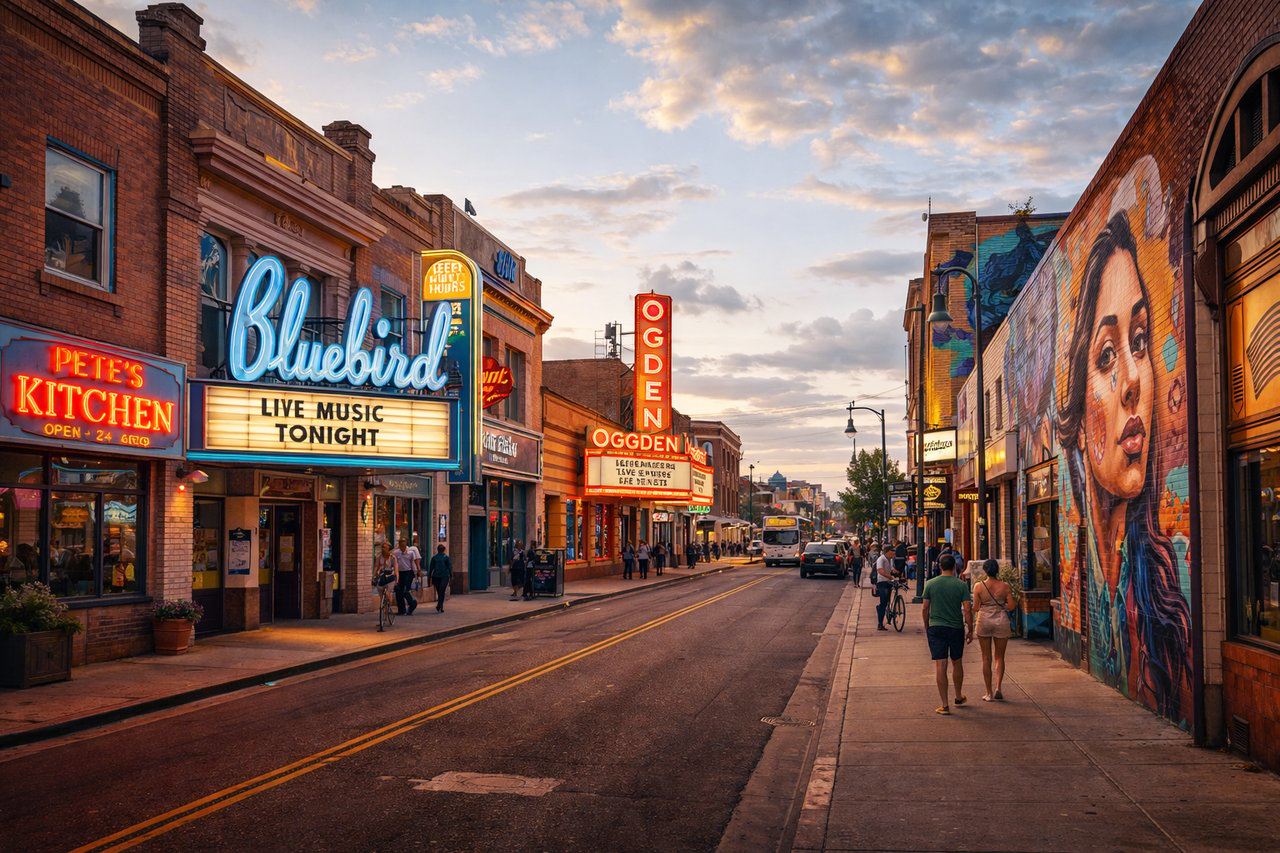
Today, the neighborhood is one of Denver's most culturally diverse, with immigrants, artists, entrepreneurs, and families who have lived here for generations. Colfax is often called the longest commercial street in America, and many of the old motels are being converted to housing and other uses.
Colfax is a long corridor, and character varies by block. Montclair, Lowry, and Stapleton (now Central Park) are among the neighbors that shape the east side's identity, so walk the specific blocks you are considering.
For a broader comparison, read my Denver neighborhood guide organized around lifestyle, budget, and goals.
You can also explore my City Park neighborhood guide, Skyland neighborhood guide, and Hale neighborhood guide to compare other central Denver options.
East Colfax Real Estate: What to Expect in 2027
East Colfax's housing is dominated by post-war single-family homes, along with some older bungalows and cottages, duplexes, small apartment buildings, and newer infill. Condition ranges from original to extensively renovated.
Rather than give you generic numbers, I prefer to provide accurate pricing based on current market conditions and the type of home you are considering. Whether you are looking for a starter home, a renovated property, or a multi-unit building in East Colfax, I can help you understand where it fits in the local market.
Location within the neighborhood makes a real difference. A home directly on Colfax, one a few blocks away, and one near a park or school each offer a different experience, from traffic and noise to walkability and the character of the block.
Condition and updates matter just as much. Renovated homes may have updated systems and finishes, while original-condition properties give buyers a chance to build equity through improvements.
The neighborhood attracts first-time buyers, investors, and buyers comfortable with an evolving area. Each group should evaluate the specific property rather than rely on a corridor-wide impression.
For budgeting beyond the purchase price, my Denver cost-of-living guide outlines expenses to consider alongside your mortgage.
Property Types and Pricing Considerations
- Post-war single-family homes: Offer practical layouts on modest lots. Evaluate the age of major systems, past additions, basement usability, and potential for improvement.
- Older bungalows and cottages: Bring character and compact footprints. Compare original details, insulation, windows, and the quality of any updates.
- Duplexes and small multifamily buildings: May appeal to owner-occupants and investors. Review legal configuration, permits, rent rolls where applicable, and metering and systems.
- Renovated homes: Pair older construction with updated interiors. The scope and quality of the work matter beyond finishes, including systems and permits.
- Newer infill and converted buildings: Offer contemporary layouts or adaptive reuse. Compare construction quality, parking, and any association responsibilities.
For Buyers
Start by deciding what you want from the neighborhood: a first home you can improve, a renovated property, or a building with investment potential. Those priorities will help narrow your search.
Older homes deserve a close look beyond their appearance. Inspection findings and available records can help clarify the roof, sewer line, electrical system, plumbing, heating and cooling, foundation, and previous alterations.
Several of my posts cover the questions that come up with older homes, including buying a house with an old roof, the Denver sewer scope, and buying with an old furnace or AC.
If affordability is a priority, read my post on the best neighborhoods for first-time buyers under $600K in the Denver metro.
If you are considering an accessory dwelling unit or a multi-unit property, confirm zoning, lot requirements, utilities, and permitting for the specific address before building those plans into your offer.
Visit the property at different times of day. Traffic on Colfax and nearby arterials, evening activity, and weekday and weekend patterns can vary by block.
My Denver home buying guide explains how to evaluate homes and prepare for the purchase process.
If you are ready to narrow your options, complete my buyer questionnaire. Tell me your budget, timeline, and priorities, and we can build a focused East Colfax search.
For Sellers
An East Colfax sale should highlight what sets the home apart. Updated interiors, a flexible layout, natural light, a useful yard, and good condition can all help buyers see its value.
Buyers here compare properties carefully, so the presentation should explain what was updated and what a buyer could still do. Documentation of major work, such as systems, roofing, sewer line repairs, or additions, helps buyers understand the home's condition.
Location is part of the story. Transit access, the proximity to parks, Lowry, Stapleton, and downtown, and the cultural life of the corridor help buyers picture daily life beyond the house itself.
I can help you decide which preparation is worthwhile, whether that means maintenance, paint, lighting, landscaping, or staging, and how to price and present the property to the right buyers.
Gather available permits, warranties, service records, and information about significant improvements. For multi-unit properties, also gather lease and income documentation where applicable.
Marketing strategy matters. My comparison of Compass private exclusives, MLS exposure, and seller strategy explains how different approaches reach different buyers.
To begin exploring your home's value, use my home valuation tool.
My seller guide explains the sale process. If your move involves both selling and buying, explore the Smart Seller Game Plan.
Life in East Colfax: Parks, Local Businesses and Community
Parks and Recreation
East Colfax has neighborhood parks and playgrounds throughout, and City Park, one of Denver's largest and best-known green spaces, is within reach by bike or car. Central Park, built on the former Stapleton airfield, adds large parks and trails to the northeast.
The area's relatively flat terrain makes biking and walking practical for many errands and outings. The experience varies by address, so ride or walk the actual routes you would use.
Many East Colfax homes also have their own yards. Lot shape, landscaping, and the relationship between the house and the outdoor space determine how much of it you can use.
Park amenities, programs, and schedules change. Check current information with Denver Parks & Recreation before planning around a particular facility.
Shopping, Dining and Entertainment
Colfax is the neighborhood's commercial spine, with independently owned restaurants, bakeries, bars, shops, and services mixed with older motels, fast-food chains, and redevelopment projects. Its character changes block by block.
The broader Colfax corridor has long been known for music venues, independent theaters, and nightlife, and it appears in countless songs, films, and books. Many of the best-known venues are farther west, so the nearest option depends on your starting point.
Lowry, Stapleton, and the surrounding area add grocery stores, restaurants, and entertainment, and downtown Denver is a short drive or transit ride away.
For more on dining across the city, read my post on the best Denver neighborhoods for foodies. Explore my City Park guide for another nearby comparison.
Community and Everyday Convenience
East Colfax has a lived-in, community-oriented feel. Long-time homeowners, renters, artists, and newcomers share the blocks, and neighborhood organizations work to improve safety, public spaces, and local business.
Daily convenience depends on the property. A home near Colfax, one on a quiet residential street, and one close to a school or park each offer a different routine.
Garage access, parking, storage, and yard maintenance are also practical considerations, particularly when comparing an original home with a renovated one.
If you are moving from outside the area, my Denver relocation guide can help you compare East Colfax with your broader work and lifestyle needs.
East Colfax Architecture and Housing Character
Much of East Colfax's housing was built after World War II to serve military families, airfield workers, and a growing population. The result is a neighborhood of modest single-family homes, with some older cottages and a few notable homes from the late 1800s.
Duplexes, small apartment buildings, and former motels add variety. Adaptive reuse projects along the corridor are converting some older motels into housing and other uses.
Some homes retain original floor plans and materials, while others have updated kitchens, bathrooms, additions, or new systems. That range gives buyers a choice between a project and a finished home.
Additions and renovations vary in quality. Look at how new space connects to the original house and whether the layout supports the way you live.
For buyers planning changes, confirm zoning, setbacks, permits, and any applicable restrictions for the specific address before planning additions, accessory dwelling units, or new construction.
Getting Around East Colfax
East Colfax's location provides connections to downtown, Lowry, Central Park, the Anschutz Medical Campus, and the airport by bus, bike, and car. The best option depends on the property and where you are going.
Colfax is a major transit corridor, and bus rapid transit improvements have been under way along its length. Review current stop locations, service, and any construction before relying on an older route description.
Colorado Boulevard, Quebec Street, 17th Avenue, and I-70 provide road connections. Actual travel times depend on the route, traffic, and time of day, so test the trips you would make regularly.
For walking and cycling, the streets and crossings between a property and your destination are part of the complete route. For a comparison with other walkable neighborhoods, read my post on the most walkable Denver neighborhoods.
Parking is generally easier on residential streets than in denser neighborhoods, though it varies near Colfax. Confirm what a property includes and evaluate guest parking separately.
East Colfax Schools and Enrollment
East Colfax is within Denver Public Schools. School assignments and enrollment options should be checked using the specific property address.
Charter and private options elsewhere in Denver add other choices. A nearby school's location does not automatically establish eligibility or guarantee admission.
School choice procedures, grade levels, program availability, and transportation may affect your options. Confirm current information directly with the district before making a purchase decision.
My guide to Denver metro school districts and school choice enrollment explains the questions to ask during your search.
East Colfax Denver: Frequently Asked Questions
Is East Colfax an up-and-coming neighborhood?
It has seen reinvestment, including redevelopment of nearby Lowry and Stapleton and the conversion of older Colfax properties, while keeping its cultural identity. Conditions vary by block, so evaluate the specific property.
What types of homes are common in East Colfax?
Post-war single-family homes are the most common, along with older bungalows and cottages, duplexes, small multifamily properties, and newer infill.
How much do homes cost in East Colfax?
Pricing depends on the property's type, size, condition, improvements, and location. Tell me what kind of home you are considering, and I can provide current pricing information tailored to your search.
How competitive is the East Colfax real estate market?
The answer depends on the home and the alternatives available at the time. I can help you understand current buyer activity, pricing, and how a particular property compares with its competition.
Why is Colfax Avenue so famous?
It was once part of U.S. Highway 40, the main route into Denver before the interstate era, and it has been written about in songs, films, and books. It is often called the longest commercial street in America.
Is East Colfax walkable?
Parts of the neighborhood offer access to shops, restaurants, parks, and transit on foot or by bike, and the flat terrain helps. The experience depends on the address, so walk the actual routes you would use and evaluate crossings, sidewalks, traffic, and distance.
Can I add an accessory dwelling unit in East Colfax?
Possibly, depending on zoning, lot size, and utilities. Confirm what is allowed for the specific address before building those plans into your purchase.
What schools serve East Colfax?
East Colfax is within Denver Public Schools. Confirm current assignments, school choice procedures, program availability, and transportation directly with the district using the property's address.
What should I know before buying an older home here?
Look beyond cosmetic updates to major systems, the sewer line, the roof, the foundation, and any additions. Inspection findings and available records can help you understand the home's condition and plan for future work.
How does East Colfax compare with nearby neighborhoods?
East Colfax offers its own combination of post-war housing, corridor energy, and proximity to Lowry and Central Park. Explore my City Park guide, Skyland guide, and Hale guide to compare other central Denver locations and housing choices.
Work With Sallie Simmons in East Colfax
I'm Sallie Simmons, REALTOR® with Compass and a member of the Nostalgic Homes team. Since 2014, I've helped buyers and sellers navigate Denver real estate with local knowledge, straightforward advice, and a strategy built around their goals.
I work with first-time buyers, move-up buyers, relocators, and investors, which makes East Colfax a natural fit. For buyers, that means helping you evaluate a home's condition, location, and potential, and understand how a block feels before you commit. For sellers, it means presenting a home's updates, layout, and strengths clearly to the right buyers.
For additional information, visit my real estate FAQ page, review my seller guide, or explore my Denver neighborhood guides.
Let's Get Started
Want to learn more about the buying process? Check out this blog to learn how to get a house without overpaying. Ready to make a move now? Fill out my buyer questionnaire here, and I will be in touch to set up a call with you!
Thinking about buying or selling in East Colfax? Let's talk about your goals. Check out this blog to learn what it costs to live in Denver!
Call or text me at 662.588.2420 or visit salliesimmons.com to connect.