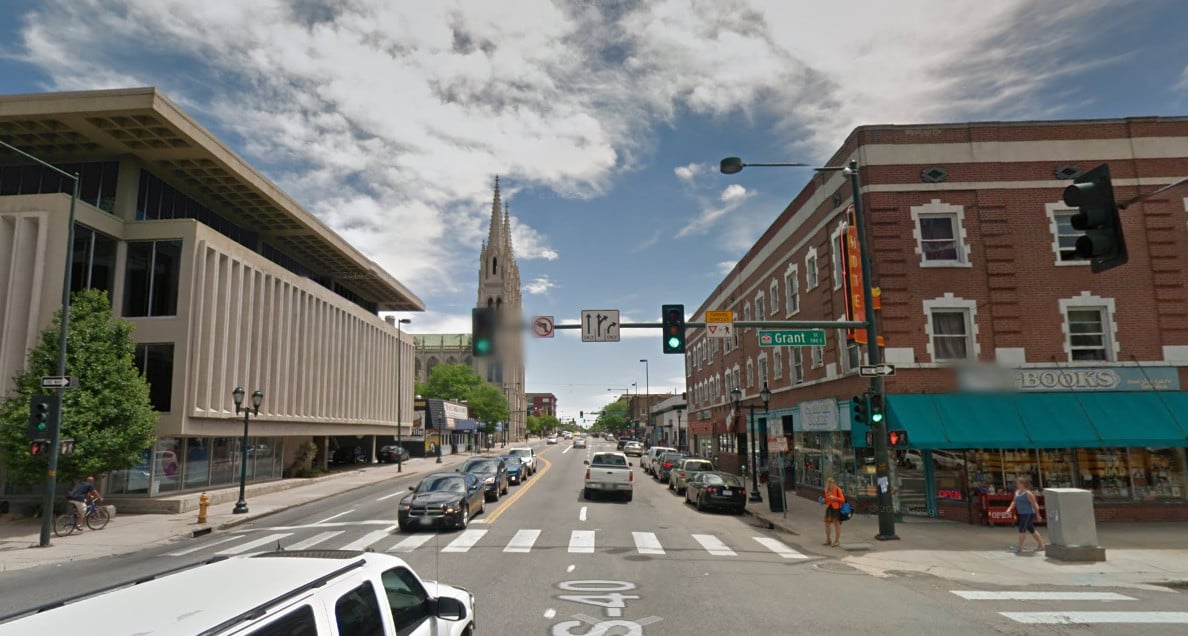
How many times over the last two years did you tell yourself you would try that new place on Colfax once the cones were gone?
If you live, work, or spend time between Broadway and Colorado Boulevard, you have spent a long time driving around barriers, navigating half-blocked sidewalks, watching construction crews occupy intersections, and wondering whether the disruption would ever end.
A major milestone arrives on September 27.
That is when the first operating phase of the East Colfax Bus Rapid Transit project begins. Routes 15 and 15L will start using new center-running bus-only lanes and center platforms, and much of the visible construction mess that has occupied this stretch since late 2024 will begin to clear. A community celebration with local businesses is planned for September 28. RTD’s September update and Denverite’s local reporting on the reopening both describe September 27 as a real turning point for the Broadway-to-Colorado phase. [286][289]
But this is not the full finish line.
September 27 marks the beginning of Bus Only Lane Operations, or BOLO, not the launch of the complete Colfax Lynx BRT system. Full BRT service, including all planned elements of the broader Broadway-to-I-225 corridor, is currently planned for late 2027 or early 2028. Construction and corridor work continue farther east toward Aurora. [285][300]
What is easy to miss beneath two years of orange barrels is that Colfax did not go quiet while it was being rebuilt. New restaurants, bars, retail concepts, and hospitality businesses opened along or near this stretch during construction, not after it.
That timing matters because it says something about East Colfax that “the road is finally open” does not: people were still willing to bet on this street while it looked like the worst possible time to bet on anything.
What Actually Changes on September 27?
September 27 is the first operational shift for the rebuilt central Denver portion of the project.
Routes 15 and 15L will begin using new center-running bus-only lanes between Pennsylvania Street and Colorado Boulevard. Riders will board and exit at new center platforms designed around the future BRT system. RTD says the new stations include level boarding, interior bike racks, and additional safety features. [285][287]
For drivers, reopening does not mean Colfax returns to the way it functioned before construction.
The corridor has been reconfigured around center-running bus lanes, new center platforms, curb medians, and revised traffic and turning patterns. The exact street configuration varies by block, but the basic point is clear: drivers should expect Colfax to function differently than it did before construction began.
For riders, the immediate change is more concrete. The 15 and 15L move into the center lanes, and passengers begin using the new stations.
Milestone | Date or Status |
|---|---|
Central Denver phase construction begins | Late 2024 |
Routes 15 and 15L begin Bus Only Lane Operations | September 27, 2026 |
Community celebration with East Colfax businesses | September 28, 2026 |
New center platforms begin serving riders | September 27, 2026 |
Full East Colfax BRT system | Currently planned for late 2027 or early 2028 |
Full project corridor | Approximately 8.5 miles, from Broadway to I-225 in Aurora |
RTD describes the full project as an approximately 8.5-mile BRT investment from Broadway in Denver to the I-225 corridor in Aurora. The project is being delivered through a partnership involving the City and County of Denver, RTD, the City of Aurora, and other public agencies. [286]
What Drivers and Riders Should Expect
If you drive East Colfax regularly, do not assume “reopening” means a return to the old lane pattern.
The point of the project is to change how the street works for buses, cars, pedestrians, cyclists, and businesses. Expect new center bus lanes, new platform locations, revised turning patterns, and a transition period while everyone learns the new configuration.
If you ride the 15 or 15L, expect to use the new center stations between Pennsylvania Street and Colorado Boulevard. RTD has identified the September 27 service change as the start of new center-lane operations for those routes. [287]
If you live or work farther east, particularly beyond Colorado Boulevard, remember that this reopening applies to the central Denver phase. Construction and other corridor work continue farther east toward Aurora.
Before heading out, check RTD’s official East Colfax BRT update for the latest station, route, and service information.
The List You Actually Want: What Opened During Construction
Here is what makes this stretch of Colfax more interesting than a simple transportation-project update.
Several new food, drink, retail, and hospitality concepts opened on or near the corridor while the street was still surrounded by construction equipment, detours, barriers, and inconsistent sidewalk access.
- Good Bones Colfax at 1201 East Colfax Avenue, a coffee shop that also carries vintage clothing and guitars, with a small performance component through a partnership with the Ogden Theatre.
- Carw Gwyn near Marion Street, a medieval mead bar that took over a space previously occupied by Kinga’s Lounge and, briefly, the Mansion.
- Japon near Colfax and Madison, serving sushi, ramen, hibachi, and teriyaki in the former Fox Run Cafe space.
- Hong Kong Station 3 near Colfax and Gaylord, a new location for the local Chinese takeout business.
- Ma’s Kitchen near Colfax and York, bringing dim sum and noodles to a space that had been vacant after Rolling Pin Pizza closed.
- FiNO inside the renovated All Inn Hotel, a former 1950s motor inn that has been transformed into a boutique property with Mediterranean small plates and a wine-garden approach to dining.
That is a meaningful number of businesses choosing to open along a corridor that was still difficult to access and visibly under construction.
If you assumed a torn-up street would stop every new business from opening, East Colfax did not get that memo.
Denver has also been encouraging residents to support businesses affected by the construction through its We Back the Fax campaign. The City’s message is simple: East Colfax businesses remain open before, during, and after construction, and they need local support to make it through the transition. [318]
The Corridor Did Not Empty Out. It Got Harder to Operate On.
That does not mean construction was harmless.
It was not.
Long-running businesses have described blocked sidewalks, difficult access, diverted traffic, lost visibility, and the challenge of convincing customers that they were still open. Newer businesses had to deal with entrances that were, at times, difficult to reach on foot. Owners who had built customer bases over decades had to absorb a period when the normal ease of stopping in, parking, walking past, or seeing a storefront from the street was disrupted.
Some businesses did not make it through. Middleman and Q House closed during the construction period. Other longtime Colfax names, including Pete’s Kitchen, Lion’s Lair, the Squire, Champagne Tiger, and Mama Jo’s Biscuits & BBQ, have all had to operate through a period when customer access was more complicated than normal.
The Nob Hill Inn became one of the most visible examples of the strain. The nearly century-old Colfax bar warned in early September that it could close by September 30 after construction hurt access and revenue. A community fundraising push later helped it remain open, but the episode made the business-side cost of the project impossible to ignore. The Denver Post reported on the fundraising effort that kept Nob Hill open, following earlier coverage of its potential closure by Denver7 and 9NEWS. [310][311][301]
That is why this is not a clean story of decline or a clean story of comeback.
It is both.
Colfax lost businesses. It kept many long-standing businesses open. It added new ones. It became harder to run a storefront on, and people still chose to open storefronts anyway.
That is a strange combination if you sit with it for a minute. A construction zone usually reads as a reason to wait. Instead, businesses kept taking their shot on the corridor while owners who had already committed to Colfax worked to survive the transition.
Denver Did Offer Business Support, but Support Does Not Erase Lost Revenue
The City of Denver did not ignore the construction impact entirely.
Denver Economic Development & Opportunity opened applications in January for grants of up to $15,000 and technical assistance for small businesses affected by city-funded construction, including East Colfax businesses affected by BRT work. [328]
The City’s Business Impact Opportunity Fund is designed as a recovery and stabilization program for small businesses affected by city-funded construction. Denver’s current programs-and-funding page lists the BIO Fund as part of the City’s small-business support resources. [329]
That support matters. But a grant does not automatically replace two years of disrupted access, reduced walk-in traffic, customer confusion, higher costs, staff challenges, or lost routine business.
The honest story is that the corridor has needed both public support and community support to make it through the construction period.
Why New Businesses Would Bet on East Colfax Anyway
The answer is not that construction was easy or that every business was thriving.
The answer is that the street on the other side of construction is intended to function differently from the one that existed before it.
The East Colfax project is designed around moving buses through the corridor more reliably, creating center stations, improving boarding, changing the street geometry, and rebuilding a route that already carries some of RTD’s highest bus ridership.
The September 27 change is only the first operating step. The full BRT experience, including all final system elements, is still planned for late 2027 or early 2028. [285][300]
But a business opening on Colfax during construction is, in some sense, making a bet on that future street. Not simply on a street with fewer cones, but on a corridor where transit access, pedestrian movement, station activity, and nearby residential density may eventually create a different kind of customer base.
That is not a guarantee that every business will succeed. It is a reasonable explanation for why new concepts were willing to open before the project was complete.
The Building Going Up Behind the Restaurants
The food-and-drink openings are not the only visible change along this stretch of Colfax.
At 1040 East Colfax, Route 40 recently topped out. The seven-story apartment building is expected to include 210 apartments, coworking space, a fitness center, and a pool deck. Development reporting indicates that leasing is expected to begin around June 2027. Route 40’s recent topping out adds another visible sign that the corridor is still attracting investment. [297]
Route 40 sits near The Vixen, a 344-unit apartment building that has already delivered and begun leasing.
Together, the two projects represent more than 550 apartments within a few blocks of the same corridor where new food, drink, retail, and hospitality concepts have opened.
That does not guarantee that every new restaurant has a built-in customer base. But it does mean the corridor is adding residential density at the same time it is rebuilding transit infrastructure and reopening business frontage.
More residents nearby, more transit access, more station activity, and more reasons to use the corridor for something other than driving through it could change the long-term daily rhythm of this part of Colfax.
What This Means If You Live Near Colfax
For people who live in Capitol Hill, City Park West, Cheesman Park, Congress Park, Hale, Alamo Placita, Uptown, or nearby areas, the BRT project will affect daily life differently depending on the exact block.
Living near Colfax can mean convenience, transit access, restaurants, nightlife, entertainment, quick access to central Denver, and an evolving commercial corridor. It can also mean traffic, noise, commercial activity, street-parking pressure, construction, and more visible change than you would experience a few blocks away.
The reopening does not automatically change what a home is worth. It does not automatically make every nearby property more desirable. And it does not erase the fact that some buyers will love being close to transit and activity while others will prefer a quieter interior block.
But it does change the practical reality of the street.
The barriers are beginning to come down in this phase. The buses move to the center lanes. New stations become part of the daily landscape. Businesses can operate on a corridor that is no longer defined entirely by construction access.
If you are buying near a major corridor like Colfax, I would never tell you to buy simply because a future transit project sounds exciting. I would want you to understand what is already open, what remains unfinished, how the block feels at different times of day, how you will use transit, what the traffic sounds like, how parking works, and what future buyers may think about the exact location.
That is the same local, property-specific thinking that matters when buying anywhere in Denver. A major improvement can be a real amenity. It can also bring tradeoffs. The right answer depends on the actual home and the life you want to live there.
September 27 Is a Milestone, Not the Finish Line
September 27 is the day Routes 15 and 15L begin using the new center bus lanes and platforms on the Broadway-to-Colorado phase.
September 28 is the community celebration with local businesses.
Full East Colfax BRT service is still ahead, with the broader corridor currently expected to reach full completion in late 2027 or early 2028. Construction continues farther east toward Aurora. [285][286][289]
But for now, the central phase reaches a real turning point.
You get a street you can cross without constantly navigating a barrier. You get buses in the center lanes. You get new stations. You get a clearer picture of which long-standing businesses made it through, which businesses did not, and which new operators decided the future of Colfax was worth betting on before the construction was even finished.
That is a fuller story than “the road is finally open.”
It is a story about a street changing while people were still trying to live, work, eat, drink, commute, and run businesses on it.
Thinking About a Home Near East Colfax?
If you are weighing what the rebuilt corridor means for a home, a move, or a neighborhood decision near East Colfax, the right conversation is not simply whether transit is “good” or whether construction is “over.”
It is about the specific block, the property’s noise and access, parking, walkability, transit use, business activity, future construction, daily routine, and how the location will work for you and future buyers.
Reach out to Sallie Simmons when you want to talk through a Denver neighborhood or home with that level of practical detail.