An older roof does not automatically make a Denver home a bad buy. In Colorado, buyers need to think about condition, hail damage, remaining life, replacement cost, insurance coverage, deductibles, and what happens if the roof needs to be replaced sooner than expected.
You find a Denver house you love. The location works. The layout works. The home has the kind of character, yard, street, or neighborhood feel that is hard to recreate somewhere else. The inspection is moving along, and then you learn the roof is 10, 12, 15, or maybe 20 years old.
What the hell are you supposed to do with that information?
Roof age by itself does not tell me whether you should buy the house.
When one of my buyers is considering a Denver home with an older roof, I want to know what condition it is actually in, whether there is evidence of hail or wind damage, whether it is functioning as intended, what replacement might cost, and how the buyer’s homeowners insurance will cover that particular roof after closing.
I also want to know whether the policy provides replacement-cost coverage or actual-cash-value coverage, what the wind and hail deductible equals in real dollars, and whether the home has other aging systems competing for the same post-closing budget.
An older roof is not automatically a bad roof. A house that needs a roof is not automatically a bad purchase. The real question is whether you understand the condition, cost, insurance exposure, and financial risk before you own the problem.
How Long Does a Roof Actually Last in Colorado?
Expected roof life is useful context, but it is not an expiration date. A roof does not become bad the day it turns 15 or 20 years old, and a newer roof is not automatically problem-free.
Colorado is hard on roofs. Denver homeowners deal with hail, wind, intense high-altitude UV exposure, snow and ice, freeze-thaw cycles, rapid temperature swings, and occasional severe weather that can change a roof’s condition in one afternoon.
That means a 12-year-old roof in Denver may have a very different history than a 12-year-old roof in a milder climate. It may have held up beautifully. It may have sustained previous hail damage. It may have been repaired. Or it may be approaching the point where replacement needs to be planned.
Roofing Material | Common Colorado Planning Range | What Buyers Should Know |
|---|---|---|
Three-tab asphalt shingles | About 15–20 years | These roofs may have less remaining margin once they are well into that range, especially after repeated storm exposure. |
Architectural asphalt shingles | About 20–30 years | Often more durable than basic three-tab shingles, but hail, UV, wind, installation quality, and maintenance still control real-world performance. |
Class 4 impact-resistant asphalt shingles | Often 20–40+ years, depending on product and storm history | They may offer better impact resistance, but they are not hail-proof and may cost more to install. |
Metal roofing | About 40–70+ years | Metal commonly offers a longer potential service life, but seams, fasteners, flashing, coatings, installation, and storm history still matter. |
Concrete or clay tile | About 50+ years | The tile covering can be long-lived, but buyers should still evaluate underlayment, flashing, broken tiles, structure, and repair complexity. |
Flat or low-slope roofing | Varies widely by membrane and installation | Drainage, seams, ponding water, penetrations, maintenance history, and the specific material are especially important. |
Colorado-oriented roofing guidance commonly places asphalt-shingle roofs in roughly the 15–30-year range depending on type and exposure, with metal roofs often lasting 40–70+ years and tile lasting 50 years or longer. But those are planning ranges, not promises. Hail and intense UV at Colorado elevation can shorten the practical life of a roof compared with a similar roof in a less demanding environment. Colorado Roofing Association
The important point for buyers is simple: roof age tells us what questions to ask. It does not, by itself, tell us whether to walk away.
An Old Roof and a Bad Roof Are Not the Same Thing
When buyers hear that a roof is older, it is easy to mentally translate that into, “This roof is bad.” That is not always true.
I generally think about older roofs in three categories.
Older but Serviceable
The roof has age, but it may still be functioning properly and have useful life remaining. There may be normal signs of wear, but no active leaks, no clear material failure, no meaningful storm-related concern, and no immediate replacement recommendation from the professionals evaluating it.
An older but serviceable roof may still belong in the buyer’s post-closing budget. It just may not need to be treated as an emergency or an automatic demand for a seller replacement.
Damaged
There may be hail or wind damage, missing or damaged shingles, exposed fasteners, damaged flashing, deteriorated areas, signs of water intrusion, or another issue that warrants further evaluation.
Damage does not automatically mean the whole roof needs replacement. It also does not automatically mean an insurance carrier will approve a claim. But it does mean the buyer needs more useful information than “the roof is old.”
Failing
Replacement may realistically be necessary now or very soon. The roof may have widespread deterioration, active leaks, recurring repairs, clear material failure, major storm damage, or a condition serious enough to affect insurance, financing, or the buyer’s willingness to proceed.
The buyer, the buyer’s agent, and listing photos are not how we determine which category applies. A home inspector can identify concerns. A qualified roofer can provide a more specific evaluation of current condition, repairability, potential storm damage, and likely scope of work.
What Does Your Home Inspector Actually Tell You About the Roof?
A general home inspection is one of the most valuable parts of buying a Denver home. It is also important to understand what an inspector can evaluate and where the limitations of a general inspection begin.
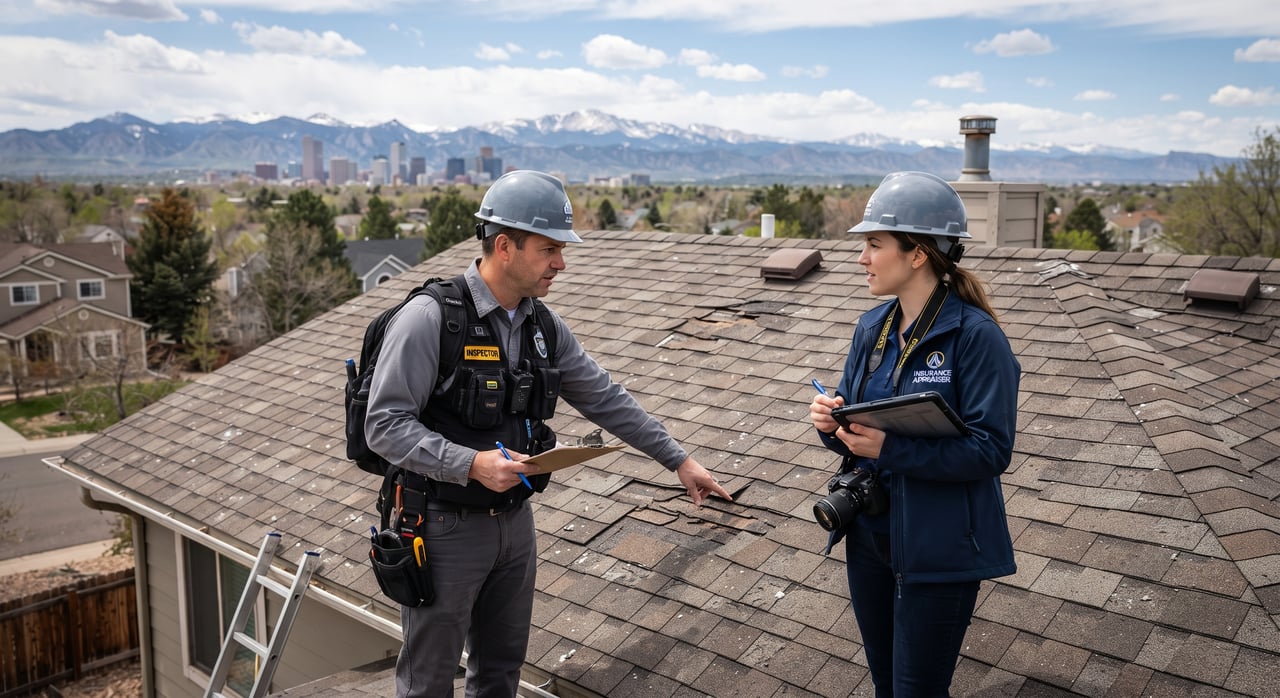
Your inspector can often provide useful observations about the roof’s approximate age, visible deterioration, missing or damaged materials, flashing concerns, gutter and drainage concerns, visible evidence of leakage, apparent storm damage, and areas that deserve additional evaluation.
That information matters. It gives buyers a professional set of observations and helps us decide whether the roof needs a roofer involved before the inspection deadline expires.
But roof observations are limited by what can safely and reasonably be seen on inspection day. Snow, rain, wind, roof height, roof pitch, access restrictions, wet surfaces, fragile materials, landscaping, and the areas visible from the ground or attic can all affect the inspection.
A home inspector can identify roof concerns. A roofer can often tell us much more specifically what is happening, whether it appears repairable, what replacement may cost, and whether there is evidence that justifies a closer insurance conversation.
For the full inspection-period context, read What Happens During a Denver Home Inspection: What Buyers Should Worry About—and What They Shouldn’t. If you are still selecting your inspection team, see How to Choose a Reliable Home Inspector in Denver: My Exact Vetting Checklist.
When I Bring in a Roofer
When an inspection raises a meaningful roof concern, I do not want a buyer sitting around guessing. “Further evaluation recommended” is not a roof diagnosis, and it is not a replacement estimate.
When I need a roof evaluated for one of my buyers or sellers, my go-to roofer is Andrew Torres with Emulous Roofing. Andrew can evaluate the actual condition of the roof, help determine whether we are dealing with ordinary aging, repairable issues, or potential storm damage, and provide real information about what the roof may need.
That matters because buyers can be making a five-figure decision based on the roof. If the property needs a $15,000, $20,000, or larger project, the buyer deserves to understand that before closing—not after the home is theirs.
A roof-specific evaluation may help answer questions such as:
- Does the roof appear serviceable, damaged, or near the end of its useful life?
- Are the issues likely repairable, or does the roof point toward replacement?
- Is there evidence consistent with hail or wind damage?
- What would a replacement cost for this actual house today?
- Are flashing, ventilation, gutters, decking, skylights, or other components likely to add to the scope?
- Would the condition justify discussing a possible seller insurance claim if legitimate storm damage is present?
Andrew cannot guarantee that an insurance company will approve a claim or pay for a roof. The insurance carrier makes that decision under the actual policy. What an experienced roofer can do is identify and document legitimate damage, explain what they see, and make sure the roof is evaluated with knowledgeable roofing input rather than guesswork.
What Does Roof Replacement Cost in Denver?
Roof replacement in Denver is not a one-number conversation. Google may tell you that “a roof costs $12,000,” but that is not the same thing as having a roofing contractor evaluate the actual house you are considering.
For many Denver single-family homes, a full asphalt-shingle roof replacement may land in the mid-teens to $20,000-plus range. Current Denver-area roofing guidance places many average asphalt-shingle replacement projects around $15,000–$20,000, while broader local estimates commonly run from roughly $12,000 to $28,000 depending on the property and scope. Denver-area roof-cost guidance and other local estimates both support using a broad planning range rather than a single national-average number.
That does not mean every roof costs $20,000. A small, straightforward, single-story roof may cost less. A larger home with a steep pitch, complicated roofline, multiple stories, damaged decking, premium material, extensive flashing, difficult access, or solar equipment can cost significantly more.
Roof-replacement cost can change based on:
- Roof size and total square footage
- Pitch, height, complexity, valleys, dormers, and multiple roof planes
- Number of stories and site accessibility
- Existing roofing layers that need removal
- Decking condition discovered after tear-off
- Shingle or roofing-material selection
- Class 4 impact-resistant materials
- Flashing around chimneys, vents, skylights, and roof transitions
- Ventilation improvements
- Gutter replacement or repair
- Disposal, permits, and code-related requirements
- Satellite dishes or other roof-mounted equipment
- Solar-panel removal and reinstallation where applicable
- Repairs discovered once the existing roof material is removed
The point is not to scare buyers with the biggest possible number. The point is to make sure they do not under-budget based on a generic internet estimate that has nothing to do with the specific roof, house, and project they may inherit.
Colorado Buyers Need to Think About Insurance Before Closing
For buyers considering an older roof, the question is not simply, “Can I insure this house?”
The better question is, “How will this particular roof be insured?”
Depending on the roof’s age, condition, material, storm history, and the insurer’s underwriting standards, the roof can affect available coverage, premium, deductible structure, and whether roof losses are covered on a replacement-cost or actual-cash-value basis.
My go-to insurance resource for Denver buyers is Rebekah Wright with Comparion Insurance Agency. When we are dealing with an older roof, I want my buyers asking about the actual roof coverage, wind and hail deductible, and potential options before they own the house.
Do not wait until closing to understand the roof portion of your homeowners policy. By then, the buyer may have already made decisions about purchase price, repairs, credits, reserves, and whether they are comfortable taking on the property.
Before closing, I want buyers to understand:
- Whether homeowners insurance is available on terms they consider acceptable
- How the roof is covered under the proposed policy
- Whether roof losses are addressed on a replacement-cost or actual-cash-value basis
- Whether wind and hail have a separate deductible
- Whether that deductible is fixed in dollars or calculated as a percentage
- What the deductible equals in actual dollars
- Whether the roof’s age or condition changes underwriting, premium, or coverage options
- Whether supplemental wind and hail protection may be available and appropriate
Replacement Cost Value vs. Actual Cash Value
A lot of buyers do not realize that roof coverage can be structured differently. That difference can matter enormously when the roof is older.
Replacement Cost Value (RCV)
Replacement Cost Value, often called RCV, generally refers to coverage that works toward the cost of replacing covered damaged property with comparable new materials, subject to the policy’s terms, limits, conditions, exclusions, and deductible.
That does not mean every policy pays every roofing-related cost in every situation. The policy language, coverage limits, applicable deductible, prior condition of the roof, exclusions, and nature of the damage all matter. But replacement-cost coverage is generally different from coverage that accounts for depreciation based on the roof’s age and condition.
Actual Cash Value (ACV)
Actual Cash Value, often called ACV, generally means depreciation is part of the calculation. With an older roof, that can significantly reduce the amount available for a covered loss compared with a replacement-cost structure.
Here is a simplified hypothetical example. It is not a promise of coverage and it is not how every carrier calculates every claim:
Example Item | Illustrative Amount |
|---|---|
Replacement cost for a covered roof loss | $20,000 |
Depreciation applied to an older roof | -$7,000 |
Wind and hail deductible | -$10,000 |
Potential owner out-of-pocket exposure | Potentially much larger than expected |
The actual claim outcome depends on the policy, deductible, scope, covered event, roof condition, and carrier determination. But the key point is simple: “I have homeowners insurance” does not tell me how much money you will receive if a hailstorm damages your roof.
Your Wind and Hail Deductible May Be Bigger Than You Think
Colorado buyers should pay very close attention to the wind and hail deductible. It may be a fixed dollar amount, or it may be a percentage deductible tied to the applicable insured dwelling value.
A percentage deductible does not necessarily mean you pay that percentage of the roof-replacement invoice.
For example, assume the home has $750,000 in applicable dwelling coverage and the policy carries a 2% wind and hail deductible:
$750,000 × 2% = $15,000 deductible.
That can completely change a buyer’s perception of risk. A homeowner could experience a covered hail event and still need to come up with $15,000 before the homeowners policy contributes toward the loss, subject to the policy terms and claim determination.
When Rebekah gives us insurance options, I do not only care about the annual premium. I care about what happens financially when the damn hailstorm actually comes.
Buyers should ask, “What is my wind and hail deductible in actual dollars?” not merely, “What percentage does the policy show?” Colorado-focused insurance guidance notes that homeowners policies may include separate wind/hail deductibles and may limit roof coverage through ACV treatment or roof-payment schedules, which makes policy-specific review important. Colorado hail-insurance overview
What Is Sola, and Why Might a Colorado Buyer Want to Know About It?
Sola is a standalone supplemental wind and hail coverage option designed to work alongside a traditional homeowners policy. It does not replace homeowners insurance.
For some homeowners, supplemental wind and hail coverage may be worth discussing when a traditional policy has a large fixed deductible, a percentage wind-and-hail deductible, or other meaningful out-of-pocket exposure following a qualifying storm event.
Sola is not a way to avoid replacing an already failed roof, and it is not a substitute for routine maintenance, roof inspections, or standard homeowners insurance. It is a separate coverage conversation that may help certain homeowners address deductible-related risk when a qualifying event occurs.
Insurance resources describe Sola as supplemental coverage that works beside a homeowners policy and may help with certain large wind and hail deductible exposures after a qualifying event. Read a general overview of Sola wind and hail coverage.
Rebekah Wright is my go-to insurance agent for Sola policies. If Sola may make sense for a particular property, she can explain the available coverage alongside the buyer’s traditional homeowners options so they understand the whole insurance picture—not just one policy in isolation.
Talk with Rebekah Wright about homeowners and Sola coverage.
What If the Roof Has Hail Damage?
An old roof is not automatically an insurance claim.
Insurance does not replace a roof simply because it has reached a certain age or because a homeowner wants a new one. There needs to be a covered event and legitimate covered damage under the applicable policy. Normal wear and tear, maintenance issues, and age-related deterioration are not the same thing as covered hail or wind damage.
If there appears to be legitimate storm damage, that is where an experienced roofer can become especially valuable. One reason I trust Andrew Torres at Emulous Roofing is that, when legitimate hail or storm damage is involved, he can work with the homeowner through the claim process and meet the insurance adjuster at the property.
He can point out the damage he believes should be included and advocate for a thorough evaluation of the roof. He cannot guarantee that an insurance carrier will cover a claim. The carrier decides coverage under the policy. But having an experienced roofing professional there can help ensure legitimate damage is identified and documented while the adjuster evaluates the property.
That is very different from promising that “insurance will buy a new roof.”
Can the Seller’s Insurance Replace the Roof Before Closing?
Potentially—if there is legitimate covered damage and the seller’s insurance carrier approves the claim.
But buyers should be careful not to treat that as automatic.
- A buyer cannot force an insurance carrier to approve a claim.
- Roof age alone is not an insurance event.
- Wear and tear is not the same thing as storm damage.
- The seller owns the policy and controls whether to pursue the claim.
- Coverage depends on the seller’s actual policy, deductible, history, documentation, and the carrier’s determination.
- An approved claim can affect transaction timing, contractor scheduling, material availability, and the final scope of work.
If there is a legitimate claim and the seller agrees to complete a replacement before closing, that can be a great outcome for the buyer. But we deal with the actual facts of the particular property rather than assuming insurance will solve the issue.
When a roof is being replaced as part of a transaction, buyers can often have input on the new roof color. That depends on the seller’s agreement, the insurance-approved scope, material availability, HOA requirements where applicable, contractor timing, and the terms we negotiate. It is not guaranteed, but it can be a real upside: the buyer may move into the house with a new roof in a color they actually like rather than inheriting a choice made years earlier.
If a Class 4 upgrade is available, the buyer and seller may also need to decide how any upgrade cost will be handled. The carrier may pay only for the approved covered scope, while a buyer who wants a premium product, a certain color line, or an upgrade beyond that scope may need the parties to negotiate the difference.
Should You Ask the Seller to Replace an Older Roof?
Not automatically.
The right request depends on the roof’s actual condition, the inspection findings, the roofer’s evaluation, the insurance situation, the home’s price, the market, the contract, and the buyer’s overall financial position.
Old but Functioning
If a roof is simply older but remains serviceable, has no documented material defect, and does not create an insurance issue, there may be nothing currently defective for the seller to replace. The buyer may decide to proceed while planning for a future roof expense.
Material Damage or Failure
If the inspection or roofer identifies material damage, active leakage, a failing condition, or legitimate storm-related concerns, the conversation changes. Repair, replacement, a seller credit, price adjustment, or another negotiated outcome may be appropriate depending on the facts.
Roof Age Creates an Insurance Problem
If the roof’s age or condition affects the buyer’s ability to obtain acceptable homeowners coverage, creates an unacceptable deductible or ACV exposure, or complicates financing, the roof may become a major transaction issue even if it is not currently leaking.
The Home Is Already Priced for Its Condition
A house with an older roof may already be priced below comparable homes with newer roofs and updated systems. In that case, the buyer may be receiving the condition discount up front. That does not make the future roof expense disappear, but it changes the negotiation context.
Depending on the situation and contract, outcomes may include repair, replacement, a seller concession where appropriate, a price adjustment, the buyer accepting the condition, or the buyer terminating when permitted under the contract.
There is no universal answer. The best option is the one that makes sense for the home and protects the buyer’s broader position. For more on that kind of decision-making, read Beyond the Contract: The Art of Negotiation in a Competitive Denver Market.
If roof condition becomes part of a broader conversation about price and value, it also helps to understand what happens when a Denver home does not appraise for the contract price.
A Brand-New Roof Is Not Automatically a Good Roof
Listings love to say, “NEW ROOF!”
That can be great news. But I still want buyers to ask follow-up questions.
- Who installed the roof?
- When was it installed?
- What materials were used?
- Was it permitted where required?
- Was damaged decking addressed if needed?
- How was flashing handled around chimneys, vents, skylights, and roof transitions?
- Is there an invoice, completion documentation, or warranty?
- Is the warranty transferable?
- Was it an insurance replacement?
- Is it impact-resistant material?
- Were gutters, ventilation, drip edge, pipe boots, and other related components addressed?
New and properly installed are not synonyms. A recent roof can be a major advantage, but buyers should still understand what was done and retain the documentation for maintenance, insurance, and future resale.
What About Class 4 Impact-Resistant Shingles?
Class 4 impact-resistant shingles deserve a more serious conversation in Colorado than they might in many other markets.
Denver and the Front Range are hail country. A roof here is not only dealing with normal aging. It is dealing with strong sun at altitude, wind, snow, ice, freeze-thaw cycles, and the possibility that one serious hailstorm can materially change its condition.
Class 4 is the highest impact-resistance classification under the UL 2218 standard. To earn that rating, a product must withstand impact testing involving a 2-inch steel ball dropped from 20 feet without cracking the shingle mat. It does not mean the roof is indestructible or that it cannot be damaged in a severe storm. It means the material has met a higher impact-resistance standard than lower-rated products. Colorado Roofing Association guidance on Class 3 vs. Class 4 shingles
Why Denver Buyers Should Care
For a Denver buyer, the question is not simply, “Are Class 4 shingles better?” The practical question is, “If this roof needs replacement, does a Class 4 upgrade make sense for this house, this insurance situation, and my long-term ownership plan?”
Class 4 shingles may offer better resistance to hail impact than standard asphalt shingles. In a hail-prone market, that can be an important long-term consideration. They can also be relevant to insurance. Some carriers may offer a premium credit or other pricing advantage for qualifying impact-resistant roofs, but that is never universal and should not be assumed.
The available benefit may depend on the insurer, policy, property location, exact shingle product, documentation, and whether the product is listed as eligible by the carrier. Some Colorado roofing sources describe potential insurance premium credits for qualifying impact-resistant roofs, but buyers should confirm the specific benefit with their insurance agent before including it in the decision. Denver-area impact-resistant roofing and insurance context
Class 4 Does Not Mean Hail-Proof
This distinction matters. A Class 4 shingle is not a guarantee that the roof will never sustain hail damage. No roofing material eliminates every risk from every storm.
Storm intensity, hail size, wind direction, roof slope, roof age, prior wear, installation quality, flashing condition, and other roof components can all affect the outcome. A Class 4 roof may perform better than a standard shingle roof in certain hail events, but homeowners should not assume it is immune from damage or that insurance questions disappear.
What Does a Class 4 Upgrade Cost?
Class 4 impact-resistant shingles generally cost more than standard architectural asphalt shingles. The actual difference depends on the manufacturer, product line, roof size, complexity, color, contractor, installation details, and the overall scope of work.
On a full Denver roof replacement, that can mean an added cost of several thousand dollars. Whether it makes sense depends on the buyer’s insurance options, how long they expect to own the home, their tolerance for hail risk, the roof’s prior storm history, and the details of the specific replacement project.
I would not make that choice by asking only, “What is the cheapest shingle?” I would ask Andrew what material makes sense for the roof and ask Rebekah how the actual insurance options may change with a qualifying Class 4 product.
If the Roof Is Replaced Before Closing
If a seller is replacing the roof before closing because of legitimate storm damage or a negotiated agreement, this is the moment to discuss materials rather than treating replacement as a simple checkbox.
Depending on the deal terms, insurance-approved scope, contractor availability, HOA rules, timing, and seller agreement, buyers can often have input on the replacement. That may include the roof color, the shingle line, and whether a Class 4 upgrade is available.
Buyers should not assume that input is automatic. The seller owns the property before closing, and the insurance carrier may determine the covered scope of a claim. A Class 4 upgrade may also require agreement about who pays any amount above the approved insurance scope.
But when there is an opportunity to replace an aging or damaged roof before closing, a buyer may be able to move into the home with a new roof in a color they actually like and a material choice that better fits their long-term ownership plans.
Keep the Documentation
If a Class 4 roof is installed, keep the paperwork. It can matter for insurance, resale, maintenance, warranties, and future claims.
- Contractor invoice identifying the exact product installed
- Manufacturer documentation showing the UL 2218 Class 4 rating
- Permit and final-inspection documentation where applicable
- Warranty information and any transfer instructions
- Photos of the completed project
- Proof of any insurance-credit request or policy update
Do not assume the insurer will know the roof is Class 4 simply because the contractor installed it. Ask your insurance professional what documentation they need and make sure the policy reflects any applicable roof-related credit or endorsement.
Solar Panels, Roof Replacement, and Timing
If the home has solar panels, roof replacement can become more complicated and more expensive than a standard roof estimate suggests.
Panels may need to be removed before the roof is replaced and reinstalled afterward. That can create separate costs, coordination, timeline issues, and warranty questions. Buyers should find out who owns the solar system, whether it is financed or leased, what removal-and-reinstallation costs may be involved, and whether the roof contractor’s estimate includes that work.
Do not assume that a roof-replacement quote automatically includes solar-related work. If the house has solar, the roof and solar conversations need to happen together before a buyer decides whether a replacement is affordable or negotiable.
When Would an Older Roof Actually Make Me Reconsider the House?
I would not tell one of my buyers to walk away from a great Denver house simply because the roof is old.
I want to know what condition it is in, whether there is storm damage, what replacement would realistically cost, how the buyer’s insurance will cover it, what their deductible will be, and what else the house needs.
An older roof concerns me more when it appears alongside other major risks:
- An old roof plus an aging furnace, AC, boiler, or heat pump
- An old roof plus a questionable sewer line
- An old roof plus substantial electrical work
- An old roof plus windows, plumbing, drainage, or foundation concerns
- An old roof plus no meaningful cash reserves after closing
- An old roof plus homeowners insurance the buyer cannot obtain or does not consider acceptable
- An old roof plus a high deductible or ACV exposure the buyer does not understand
- An old roof plus a seller unwilling to address legitimate material damage
- An old roof plus a price that does not reflect the home’s condition
That is the bigger question behind buying a home with deferred maintenance. The house may still be right. But the buyer needs to know whether they are buying a manageable future expense or signing up for several expensive systems at once.
For more perspective on weighing condition, cost, and long-term ownership risk, read The Biggest Regrets Denver Home Buyers Have—and How to Avoid Them.
The Roof Does Not Exist in a Vacuum
A $20,000 roof on an otherwise fantastic house may be manageable. The home may have a newer furnace, a good sewer line, solid electrical, a buyer with healthy reserves, acceptable insurance, and a purchase price that makes the project worthwhile.
A house that needs a $20,000 roof, $15,000 in HVAC work, a $20,000 sewer repair, electrical improvements, and windows is an entirely different financial proposition.
That is why I encourage buyers to evaluate the full cost of ownership rather than fixating on one inspection item. The roof matters. So do the HVAC system, sewer line, electrical service, insurance, property taxes, routine maintenance, and the amount of money the buyer has left after closing.
Read Just Because You Can Afford It Doesn’t Mean You Should: How Much House Should You Actually Buy in Denver? for the broader affordability conversation. Before you start shopping, use How to Decide Your Home Budget in Denver Before You Ever Talk to a Lender to think through the numbers beyond the monthly payment.
If the house has aging heating and cooling equipment as well, see Buying a Denver Home With an Old Furnace or AC: What Buyers Need to Know.
For broader context on older local housing stock and the quirks buyers often inherit, read 12 Things About Denver Homes That Might Surprise You.
Questions I Want Denver Buyers Asking About the Roof
When a buyer is considering a Denver home with an older roof, these are the questions I want answered before the inspection period ends:
- How old is the roof?
- What roofing material is it?
- Has there been prior hail or wind damage?
- Have there been previous repairs, leaks, or insurance claims?
- What does the home inspection report say?
- Should Andrew or another qualified roofer evaluate it?
- Is there legitimate storm damage?
- What would replacement cost for this actual house today?
- How will the available homeowners-insurance options cover this roof?
- Is roof coverage RCV or ACV?
- What is the wind and hail deductible in actual dollars?
- Would supplemental Sola coverage be available and appropriate?
- Are there solar panels that would need to be removed and reinstalled?
- If replacement happens before closing, can the buyer have input on shingle color and material selection?
- Would a Class 4 impact-resistant upgrade make sense?
- How much money will the buyer have left after closing if the roof becomes their expense?
Frequently Asked Questions
How old is too old for a roof when buying a Denver home?
There is no single age that automatically makes a roof too old to buy. A roof at or beyond a typical service-life range deserves closer attention, but its present condition, storm history, inspection findings, roofer input, replacement cost, insurance terms, and the buyer’s cash reserves matter more than age alone.
Can you get homeowners insurance with an older roof in Colorado?
Often, yes. But the roof’s age and condition can affect underwriting, coverage options, premium, deductible structure, and whether roof losses are covered on a replacement-cost or actual-cash-value basis. Buyers should obtain and review insurance options before closing.
Does homeowners insurance replace an old roof?
Not simply because it is old. Insurance generally requires a covered event and legitimate covered damage, subject to the policy terms, exclusions, limits, and deductible. Wear, deferred maintenance, and normal age-related deterioration are not automatically covered losses.
What is ACV roof coverage?
Actual Cash Value coverage generally accounts for depreciation. With an older roof, that can reduce the amount available for a covered loss compared with replacement-cost coverage, and the homeowner may still owe the applicable deductible.
What is RCV roof coverage?
Replacement Cost Value coverage generally works toward the cost of replacing covered damaged property with comparable new materials, subject to policy terms, limits, conditions, and deductible. Buyers should review the actual policy because coverage details vary.
What does a 2% wind and hail deductible actually mean?
It may mean the deductible is 2% of the applicable insured dwelling value rather than 2% of the roof invoice. For example, 2% of $750,000 is $15,000. Buyers should ask their insurance professional to confirm the exact deductible in dollars for the policy they are considering.
What is Sola wind and hail coverage?
Sola is a standalone supplemental wind and hail coverage option designed to work alongside—not replace—a traditional homeowners policy. It may be worth discussing when a homeowner has a large wind and hail deductible or other meaningful storm-related out-of-pocket exposure.
Does Sola replace homeowners insurance?
No. It is supplemental coverage, not a replacement for homeowners insurance. A buyer should review how it fits into their overall coverage plan with a qualified insurance professional.
Can a seller’s insurance replace a hail-damaged roof before closing?
Potentially, if there is legitimate covered storm damage and the seller’s carrier approves the claim. The seller owns the policy and controls the claim, while the carrier determines coverage. Buyers should not assume insurance will automatically pay for an older roof.
Should I have a roofer inspect the roof before buying?
It is often a smart next step when the home inspection identifies a meaningful roof concern, the roof is older, the buyer needs a realistic replacement estimate, potential storm damage is present, or insurance and negotiation decisions depend on better information.
Should I ask a seller to replace an older roof?
Not automatically. The right request depends on whether the roof is old but serviceable, materially damaged, failing, creating an insurance problem, or already reflected in the home’s price. Repair, replacement, credit, price adjustment, acceptance, or termination may each make sense in different situations.
Are Class 4 shingles worth it in Denver?
They can be worth discussing because Denver is hail-prone and Class 4 shingles have the highest UL 2218 impact-resistance rating. Whether they are worth the higher upfront cost depends on the roof project, insurance options, how long the owner expects to keep the home, and the exact material choices available. They are not hail-proof, and any potential insurance credit should be verified with the actual carrier.
Can I choose the color of a new roof before closing?
Often, buyers can have input when a roof is being replaced during the transaction, but it depends on seller agreement, insurance claim scope, contractor timing, material availability, HOA requirements, and the terms negotiated in the contract. Do not assume the buyer automatically controls the selection before closing.
Should I walk away from a Denver house that needs a roof?
Not necessarily. A needed roof can be a manageable expense on an otherwise great home. It becomes more concerning when combined with other major repairs, weak buyer reserves, unacceptable insurance terms, a seller unwilling to address legitimate damage, or a purchase price that does not reflect the home’s condition.
Put the Whole Team Together Before You Own the Problem
An older roof does not automatically make a Denver house a bad purchase. But I do not want my buyers discovering after closing that the roof needs $20,000 worth of work, their homeowners policy provides depreciated coverage, and their wind and hail deductible is another five-figure surprise.
Those are things we can investigate before you own the problem. My job is to help you understand the house, the costs, the insurance exposure, and the risk well enough to decide whether you still want to buy it.
If you need the roof evaluated, contact Andrew Torres at Emulous Roofing.
If you need to understand homeowners coverage, roof deductibles, ACV versus RCV, or whether Sola may fit your insurance plan, contact Rebekah Wright at Comparion Insurance Agency.
If you are weighing whether an older roof is normal homeowner stuff or a reason to reconsider a particular Denver home, contact me. That is exactly the kind of decision I help buyers work through before they commit.
You can also start with my Denver Home Buyer’s Guide, use my Denver Buyer Game Plan, or explore the broader Denver Real Estate Resource Center for more Denver buyer guidance.