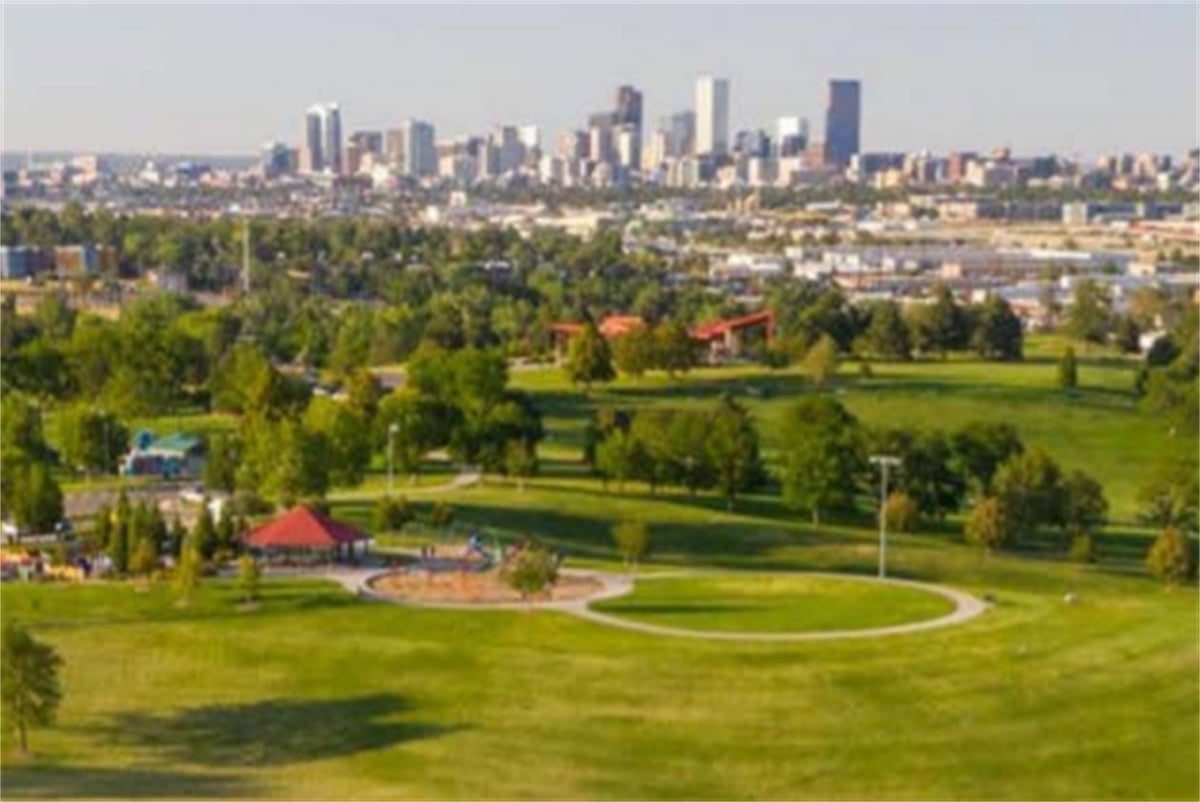
Denver plans to rebuild part of the gulch to reduce flooding and improve trail connections. Neighbors want clearer answers about protecting the wildlife already living there.
On March 31, volunteers arrived at Sanderson Gulch with young chokecherry trees. Neighbors and Denver Parks and Recreation crews were planting saplings to stabilize the banks and help rebuild the tree canopy.
There was one complication: the beavers.
“It’s really challenging because they want to eat everything that we put in,” Emily Zeller, Denver Parks and Recreation’s volunteer and stewardship program manager, told Denverite in April.
Those beavers live along the same stretch of Sanderson Gulch between West Florida and West Arkansas avenues that Denver now plans to deepen, widen, and rebuild.
For residents of Denver’s Ruby Hill neighborhood, the project brings together several things that matter close to home: flood protection, trail access, mature trees, and the wildlife neighbors have spent years watching and protecting.
The disagreement is not simply whether the gulch needs improvements. City staff and neighborhood advocates both want a healthier, safer waterway. The harder question is how to get there without unnecessarily sacrificing the ecosystem already in place.
Why Denver Wants to Rebuild This Stretch of Sanderson Gulch
The city’s explanation starts with decisions made roughly a century ago.
Gordon Robertson, Denver Parks and Recreation’s director of park planning, design and construction, told Denverite in September that earlier planners squeezed the creek into a narrow, steep-sided channel to make more room for development.
“They narrowed it so much so they could squeeze as much development in as possible, and they left as little as they possibly could at a very steep angle.”
Today, city officials say that constrained channel creates problems for both flood management and habitat.
The culverts at Arkansas and Florida avenues are too small to handle a major flood event. According to Denver7’s reporting, the channel is also too shallow. Plans call for increasing its depth from approximately 15 feet to 19 feet in some locations.
The project would also improve the trail and pedestrian crossings. City officials describe the intended result as a waterway that better protects nearby homes while providing a wider, gentler channel with more opportunities for wildlife.
The Beavers Are Already Changing the Gulch
The existing channel is not an empty drainage ditch. Beavers have built dams and lodges there, and neighbors regularly observe birds and other wildlife using the corridor.
The beavers’ activity also creates management challenges.
Vicki Vargas-Madrid, a wildlife program manager at Denver Parks and Recreation, told Denverite that dams have caused water to flood public trails. She also connected the tree damage to the limited habitat available in the narrow channel.
“It’s causing the beaver to munch on as many of the trees in there as possible, because they are almost squeezing themselves out of this habitat.”
Denverite’s April reporting identified tree damage near Florida Avenue and Raritan Street. Neighbors wanted to protect the remaining canopy without driving the animals away.
That is the balancing act already underway: keeping trees alive, keeping trails usable, and allowing beavers to remain in an urban creek with very little room to spare.
How Denver Has Been Trying to Coexist With the Beavers
If you have noticed a black pipe running through a Sanderson Gulch dam, it is part of that effort.
Denverite photographed a dam in March with a pipe installed by Denver Parks and Recreation to allow water to pass through. The device helps manage water levels without simply removing the dam.
That approach fits the city’s published beaver management guidelines, which identify coexistence as a central goal.
The department’s management tools include:
- Monitoring sites with beaver activity and assessing habitat conditions.
- Protecting selected trees with wrapping or a paint-and-sand mixture.
- Leaving some less-desirable vegetation available for beavers.
- Installing water-flow control devices where appropriate.
- Considering relocation case by case, as a last resort.
In other words, Parks staff have already invested time and resources in keeping beavers in the gulch. The construction project creates a different challenge because it would substantially alter the habitat those measures are intended to protect.
What Ruby Hill Neighbors Want the City to Address
Neighbors have been working on the gulch, too, planting trees, collecting trash, and keeping track of the animals that live there.
Megan Lane, a member of the Ruby Hill Neighbors registered neighborhood organization, told Denverite that residents take pride in their beaver families.
“These are our beavers and no, you can’t displace them or you can’t degrade this ecosystem.”
Lane said concerns about the project’s effects on wildlife and the landscape date to 2019, when the proposal began taking shape.
“We essentially asked the city to take a more intentional approach and that we want to be highly involved as a community,” she told Denverite. “And then none of that ever really occurred.”
Residents are not presenting flood protection and habitat as mutually exclusive goals. In Denver7’s reporting, Lane explicitly supported flood mitigation, better water quality, and safer pedestrian and bicycle connections.
The request is to examine whether the city can achieve those improvements while retaining more of the existing ecosystem.
The Argument for Working With the Beavers
Beaver ecologist Nova Robbins-Waldstein told Denver7 that the animals already provide natural water-management benefits. She argued that the project should build on those functions rather than assume the existing habitat must be removed first.
That does not establish that beavers alone can solve the specific flood-capacity problems identified by city engineers. It does explain why advocates want a closer ecological review before construction changes the channel.
The central question is not whether engineered improvements or beavers are universally better. It is how the project can address the documented infrastructure problems while accounting for the habitat and water-management functions already present.
Will the Beavers Return After Construction?
There is no agreed-upon answer.
The city says it does not plan to remove the beavers directly, but acknowledges that construction will likely force them to leave.
At the September neighborhood meeting, Vargas-Madrid said much of the habitat would change or be removed. Parks would try to preserve some mature trees, but the work would substantially reshape the area.
“We see this as we’re exchanging the existing habitat for new habitat,” she said, according to Denver7.
Denverite reported that the project would lower the stream’s flow and remove approximately 100 trees, most of them invasive species.
Robertson expects beavers to return to the rebuilt channel. He described the future gulch as “wider and flatter and gentler,” with habitat opportunities for many species.
Robbins-Waldstein offered a different assessment, telling Denver7 that it is highly unlikely the beavers will return once displaced.
Neither expectation should be presented as a guaranteed outcome. Whether beavers return, how quickly vegetation becomes established, and how wildlife uses the rebuilt channel remain important uncertainties.
There is also no reliable population count to use as a baseline. Denver Parks and Recreation told Denverite it does not have an accurate estimate of the number of beavers living citywide, and the reporting reviewed for this article does not establish a count for this stretch of Sanderson Gulch.
What Has Been Approved, and What Still Needs to Happen?
On September 14, 2026, Denver City Council approved $20.6 million in spending for the project. Approximately $4 million comes from federal funding, with the remainder from the city and county, according to Denverite.
That funding approval is not the same as approval of a construction contract.
Denver7 reported that the Department of Transportation and Infrastructure, or DOTI, expected to seek construction bids later in 2026. A contract would then go to City Council, with review anticipated in early 2027.
Timing | Milestone | Status or qualification |
|---|---|---|
September 14, 2026 | City Council approved $20.6 million in project spending. | Reported by Denverite; separate from construction-contract approval. |
September 15, 2026 | Ruby Hill Neighbors discussed the project and requested additional ecological and community review. | Local reports characterize the support vote differently. |
Later in 2026 | DOTI anticipated seeking construction bids. | Expected timing reported by Denver7, not a confirmed bid award. |
Early 2027 | City Council was expected to review a construction contract. | Anticipated timing, subject to the procurement process. |
Late spring or early summer 2027 | Construction could begin. | Dependent on contract approval, according to Denver7. |
Spring 2029 | Construction completion listed in the city schedule cited for this article. | Planning estimate, not a guaranteed completion date. |
A Clarification About the Neighborhood Vote
The two local reports describe the September 15 meeting differently.
Denverite reported that an initial motion opposing the project ended in a tie and failed. A subsequent motion passed requesting an ecological study, a community-impact assessment, and a working group.
Denver7 described the meeting as ending with neighbors voting to withdraw support for the project as currently planned.
The shared point is clear: the neighborhood organization asked the city to do more before moving forward. The precise wording of the adopted motion matters, however, and the reports should not be treated as identical accounts of the vote.
The Design Is Largely Set. Construction Management Still Has Room to Change.
DOTI told Denver7 that the project’s core improvements are “fully designed and not expected to change.”
The department said lowering the gulch, widening the regional trail, improving crossings, and reestablishing a more natural channel work together to deliver the project’s flood, safety, and environmental benefits.
However, DOTI also said there is flexibility in how construction is managed to minimize impacts.
The department planned to contact the neighborhood organization, share ecological information already completed for the project, and discuss whether additional work was needed.
That leaves several meaningful questions to follow:
- Which mature trees can be preserved, and how will those protections be incorporated into the work?
- How will construction be phased around the creek and existing habitat?
- Will discussions with Ruby Hill Neighbors lead to additional ecological analysis or monitoring?
- What trail closures, detours, and access restrictions will be included in the construction plan?
- What commitments and schedule will appear in the contract presented to City Council?
These questions are more useful than assuming either that the entire design remains open for reconsideration or that every construction detail has already been settled.
What the Project Could Change for People Using the Trail
The work is not limited to the creek channel.
The plan includes replacing two bridge structures, improving the trail, and adding a pedestrian and bicycle underpass at Florida Avenue. The new crossing is intended to connect the south side of Florida with the elementary school to the north.
Those improvements are part of the project’s appeal. The temporary disruption required to build them is a separate consideration for people who walk, bike, or live nearby.
If construction begins in late spring or early summer 2027 as anticipated, residents will need a more detailed access and detour plan before treating any particular route as available throughout the work.
For anyone planning a move to Denver, this is an example of why it helps to evaluate both the neighborhood you can use today and the changes expected over the next few years.
What Buyers and Homeowners Near Sanderson Gulch Should Watch
A major public project can change how a location functions well before there is evidence of any effect on home prices.
For a home near Sanderson Gulch, the practical questions include construction access, trail availability, changes to nearby vegetation, and the distance between the property and the actual work area.
A flood-control project also should not be treated as a property-specific determination of flood risk or insurance requirements. Those questions require information about the individual property, not just a neighborhood project description.
If you are considering a purchase, use my Denver Home Buyer’s Guide as a starting point for the broader process, then investigate the location-specific details that could affect your decision.
If you already own nearby and are thinking about selling, the project belongs in a discussion about timing and marketing. It does not, by itself, justify predicting a price increase or decrease. Comparable sales, property condition, current competition, and buyer demand still need to be evaluated.
You can also explore my Denver neighborhood guides to compare locations and my Denver Real Estate Resource Center for more buying, selling, and relocation information.
What to Watch This Fall and Winter
Under the construction schedule described in September’s reporting, fall and winter would come before an anticipated 2027 start. That makes the next several months important for reviewing the construction approach, following the contract process, and understanding what protections will be included.
The neighborhood calendar cited for this article listed an October 10 Sanderson Gulch cleanup, with Parks loaning waders and Robbins-Waldstein scheduled to discuss working safely around beaver habitat. That listing establishes what was scheduled, not whether the event occurred as planned.
The calendar also listed a Social Club gathering at Table Public House for Tuesday, October 20. It was described as an informal get-together without an agenda, not a dedicated project meeting.
For project decisions, the more consequential next steps are DOTI’s follow-up with the neighborhood, construction bidding, and the contract that ultimately reaches City Council.
Thinking About Buying or Selling Near Sanderson Gulch?
Neighborhood projects deserve more than a quick headline when they could affect the street, trail, or open space near your home.
I help buyers and sellers put those changes into context: what has been approved, what remains uncertain, and which questions matter for a particular property.
Explore my Ruby Hill neighborhood guide, or connect with Sallie Simmons to discuss a home near Sanderson Gulch and how the proposed construction fits into your plans.