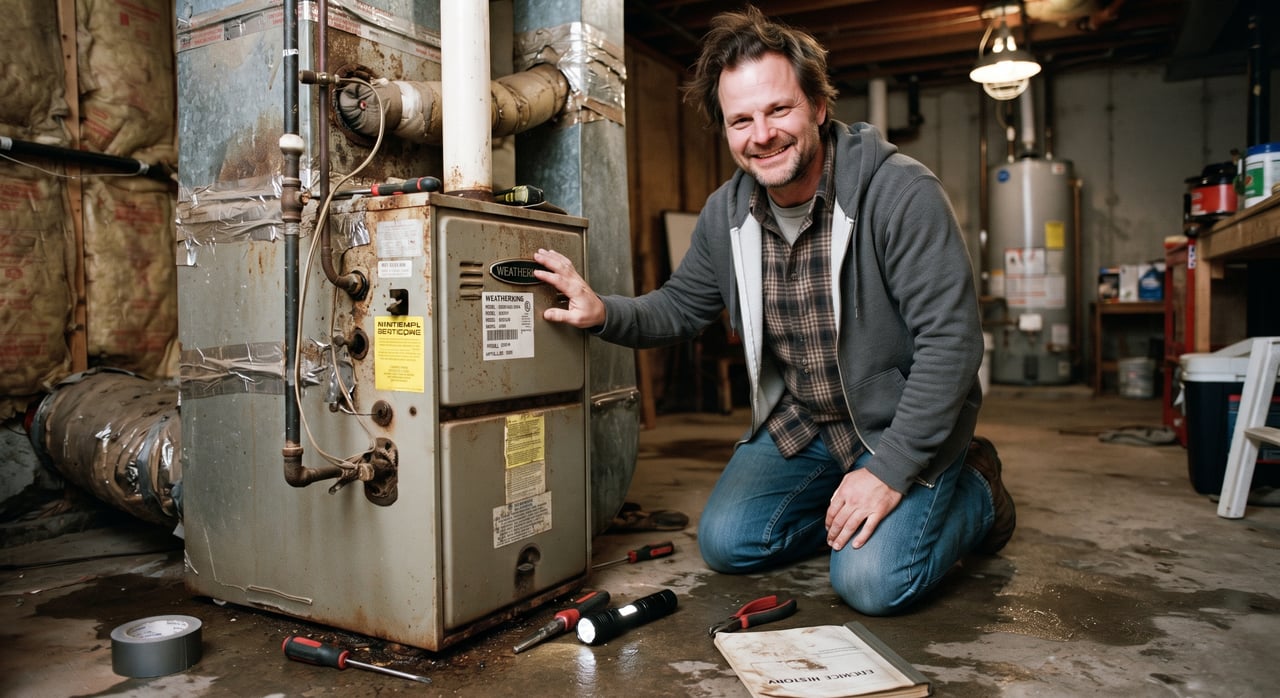
Then you walk downstairs and discover a furnace that looks like it may have been installed during the Clinton administration.
Does that mean you should not buy the house?
Not necessarily.
Older HVAC equipment is incredibly common in Denver homes, especially in older neighborhoods, brick ranches, bungalows, mid-century homes, historic properties, and homes that existed long before central air conditioning became standard. Age alone does not tell me whether my buyers should be worried. But it absolutely belongs in the bigger conversation about condition, maintenance, replacement cost, what else the house needs, and what you are paying for the property.
When I help buyers evaluate a Denver home, I do not treat an older furnace, air conditioner, boiler, or heat pump as an automatic deal-breaker. I want to know whether it is functioning, whether it has been maintained, what the inspector finds, what a qualified HVAC professional says if more evaluation is warranted, how much replacement could realistically cost, and whether the buyer can comfortably absorb that risk after closing.
The goal is not to find a house with zero maintenance risk. That house does not exist. The goal is to understand the risk you are taking on and make sure the home still makes sense for your finances, comfort level, and long-term plans.
How Long Do Furnaces and Air Conditioners Typically Last in Denver?
There is no exact expiration date for HVAC equipment. A furnace does not automatically fail the day it turns 20, and an air conditioner does not become worthless because it has reached a certain age. But typical service-life ranges give buyers a useful planning framework.
System | Typical Service-Life Range | What Buyers Should Take From It |
|---|---|---|
Gas furnace | About 15–20 years | A furnace beyond this range may still work well, but buyers should understand that significant repairs or replacement may be closer. |
Central air conditioner | About 12–18 years | Older AC units can remain operational, but component failures, efficiency concerns, and repair costs become more likely over time. |
Heat pump | About 10–15 years | Maintenance, installation quality, system design, equipment type, and cold-weather performance all affect its useful life. |
Boiler | About 15–30+ years | Many well-maintained boilers last a long time, especially older cast-iron systems, but specialized repairs and replacement planning still matter. |
Those ranges are helpful, but they are not a diagnosis and they are not an expiration date.
A well-maintained 18-year-old furnace with service records, clean equipment, no visible corrosion, good airflow, and normal operation may concern me less than a newer system that appears neglected. A 10-year-old furnace that has never been serviced, has a filthy filter, shows corrosion, cycles strangely, or has been installed poorly can create more concern than a much older system that has been properly maintained.
Likewise, a boiler can be old without being an immediate problem. Denver has plenty of homes with boilers and radiant heat, particularly in older neighborhoods. Those systems deserve a thoughtful evaluation, but “old” is not automatically the same thing as “bad.”
The better question is not, “How old is this furnace?” It is, “What does the age, current condition, maintenance history, and likely replacement cost mean for this specific house and for my budget after closing?”
Why HVAC Age Matters More When You’re Buying Than When You Already Own the House
If you already own a home with a 17-year-old furnace, you may be perfectly happy to use it until something happens. You know the house, you understand how it performs, and you may have time to set aside money for an eventual replacement.
Buying a house with a 17-year-old furnace is different.
When you buy that home, you take ownership of the risk on Day 1. The furnace may last another five years. It may need a small repair in the first winter. Or it may fail two months after closing, right when you are still unpacking boxes, buying furniture, and recovering from down payment and closing costs.
That does not mean buyers should reject every home with an aging mechanical system. It means the system has to be considered as part of the whole financial picture.
Immediate Replacement Versus Remaining Useful Life
An older furnace does not always need immediate replacement. Sometimes it is functioning normally and an HVAC professional believes it has remaining useful life. Sometimes the system is technically operational but clearly nearing the point where major repairs do not make financial sense. Sometimes the inspector identifies a condition that deserves a specialist opinion before a buyer removes inspection contingencies.
The difference matters. A buyer who is planning for a possible replacement in a few years is in a different position from a buyer who may need to replace equipment before the first Denver winter arrives.
How Much Cash You Will Have Left
One of the biggest mistakes buyers make is focusing entirely on qualifying for the purchase instead of thinking about what ownership will feel like after closing.
A buyer who has healthy reserves after closing may be comfortable buying a great house with an older furnace. They understand that replacement could become necessary and they can handle it without turning a home purchase into a financial emergency.
A buyer who is using every available dollar for the down payment, closing costs, moving expenses, furnishings, and repairs may need to be more cautious. Even if the lender approves the payment, there may not be enough room left for the realities of homeownership.
That is why I regularly encourage buyers to read Just Because You Can Afford It Doesn’t Mean You Should: How Much House Should You Actually Buy in Denver? A lender’s approval amount is not the same thing as a comfortable ownership budget.
What Else Is Aging in the House?
A 20-year-old furnace does not exist in a vacuum.
If the furnace is older but the roof is newer, the sewer line has been replaced, the water heater is recent, the electrical panel is in good condition, and the home has otherwise been maintained, the buyer may reasonably decide the HVAC risk is manageable.
But if the furnace, AC, roof, water heater, electrical panel, sewer line, windows, appliances, and driveway are all aging at the same time, the total cost of ownership can add up quickly. The HVAC system may not be the only reason to reconsider the purchase, but it may be one more major expense on a growing list.
Does the Price Reflect the Condition?
Sometimes an older-system house is priced appropriately. A buyer may be getting a better price than they would pay for a similar home with a new roof, new HVAC, newer windows, updated electrical, and a fully renovated interior.
Other times, a seller is asking updated-home money for a property with several major systems at or near the end of their useful lives. That does not necessarily mean the home is a bad purchase, but it may affect how aggressively a buyer should negotiate or what price makes sense.
Before you even begin looking seriously, it helps to build a budget around the full ownership picture. My guide on how to decide your home budget in Denver before you ever talk to a lender is designed for exactly that conversation.
What Does It Cost to Replace HVAC in Denver?
HVAC replacement costs are one of the reasons that an older system deserves real attention during the inspection period. A furnace or AC replacement is not always a five-figure problem, but it can become one quickly depending on the house, equipment, installation requirements, and related upgrades.
For planning purposes, these are realistic Denver-area ranges buyers should keep in mind. They are not quotes, and the actual cost for a particular home can vary substantially.
Project | Typical Denver Planning Range | Common Reasons the Cost Goes Higher |
|---|---|---|
Gas furnace replacement | $4,800–$9,500+ | Higher-efficiency equipment, new venting, condensate drain work, duct modifications, difficult access, equipment capacity, and code-related changes. |
Central AC replacement | $6,000–$11,000+ | Larger system capacity, higher efficiency, evaporator-coil work, refrigerant-line replacement, electrical work, access limitations, and system compatibility. |
Furnace and AC replacement together | $10,000–$20,000+ | Premium equipment, ductwork, electrical upgrades, zoning, difficult installation conditions, and major retrofit work. |
Boiler replacement | $4,500–$10,000+ | Boiler type, piping condition, radiators or radiant distribution, venting, controls, access, and whether the project is a simple replacement or a larger redesign. |
Heat pump installation | $8,000–$18,000+ | Cold-climate equipment, backup heat, ductwork, electrical capacity, panel upgrades, system design, installation complexity, and efficiency choices. |
Electrical or related complications | Can add materially to the project | Older electrical panels, insufficient service capacity, new circuits, panel upgrades, duct repair, asbestos-related issues, permits, and code-required work. |
One Denver-area pricing guide places standard central AC replacement around $6,000 to $11,000, while a combined furnace-and-AC replacement can run roughly $10,000 to $20,000 or more depending on the equipment and installation scope. Denver furnace replacement estimates commonly range from the mid-thousands for a straightforward project to $10,000 or more for higher-efficiency equipment and added venting or ductwork work. [2][4][7]
Heat-pump pricing can vary even more because the outdoor equipment is only part of the project. Electrical capacity, backup heat, ducts, sizing, controls, and installation design all affect the total. Denver-oriented heat-pump estimates commonly fall in the roughly $8,000 to $18,000 range, with more complex homes and upgrades going higher. [3]
Why the Cheapest Online Number Is Not Always Useful
Buyers often find a low replacement estimate online and assume that is the number they should use. Sometimes it is directionally useful. Often, it is not comparable to the actual cost of replacing a system in a specific Denver house.
A basic advertised price may assume ideal access, a straightforward replacement, a standard-efficiency unit, compatible existing components, no duct changes, no electrical issues, and no permits or code-driven work beyond the basics.
Real-world installation costs can change based on:
- The home’s actual heating and cooling load, rather than simply installing the same size equipment that was there before.
- Denver’s elevation and proper setup for gas-fired equipment.
- The condition, sizing, and layout of the existing ductwork.
- Access through a crawlspace, attic, finished basement, utility closet, or tight mechanical room.
- Whether a high-efficiency furnace requires new venting or condensate drainage.
- Whether the AC coil, refrigerant line, pad, disconnect, thermostat, or controls also need replacement.
- Electrical-panel capacity, dedicated circuits, or the need for a service upgrade.
- Mechanical permits, inspections, and code-related corrections.
- The brand, efficiency, warranty, comfort features, and noise level the buyer chooses.
During an inspection period, buyers do not always need a perfect quote down to the dollar. But if the HVAC condition could affect your willingness to buy the house or your negotiation strategy, it is worth getting a real estimate from a qualified Denver HVAC professional.
What I Look at Besides the Age of the System
I am not diagnosing HVAC equipment during a showing or inspection. Buyers should not rely on an agent’s visual impression instead of a qualified home inspector or HVAC technician.
But after spending a lot of time in Denver homes, there are practical things I pay attention to because they tell me when it is worth asking more questions or bringing in a specialist.
Maintenance and Service Records
Service records are not a guarantee that a system is perfect. But regular maintenance can be a meaningful positive sign, especially for an older furnace, AC unit, or boiler.
If a seller can show annual furnace service, recent repairs, filter changes, receipts, warranty documentation, or invoices from a reputable contractor, that tells a different story than a system with no records and visible signs of neglect.
Visible Condition
Rust, corrosion, staining, water around the mechanical equipment, damaged insulation, exposed wiring, deteriorated flue connections, loose ductwork, or improvised-looking repairs do not automatically prove a system needs replacement. But they are clues that deserve closer evaluation.
I also pay attention to whether the mechanical room looks generally maintained. A home does not need to look brand new to be well cared for, but obvious deferred maintenance can matter.
Whether Heating and Cooling Actually Operate
A home inspector may operate the heating system and, if weather conditions allow, the cooling system. A furnace or AC unit that is old but functioning normally is a different issue from equipment that does not operate, does not produce expected heating or cooling, makes unusual noises, or has visible safety concerns.
It is also important to remember that air-conditioning testing may be limited by outdoor temperatures. If it is too cold outside, an inspector may not operate the AC system because doing so could damage it. That can leave buyers with an older AC system that has not been fully tested during the inspection period, which may justify a more careful conversation.
Filters, Airflow, and Obvious Maintenance Clues
A severely clogged filter does not tell you everything about a furnace, but it can suggest the system has not received consistent attention. Dirty return-air areas, neglected condensate drains, heavily soiled equipment, or obvious airflow issues can also point to deferred maintenance or a system that deserves more evaluation.
Installation Quality
I pay attention to whether an HVAC installation looks orderly and professional. I am not making a technical judgment from a showing, but obvious ductwork issues, odd venting, lack of clearance, damaged supports, strange drainage arrangements, or equipment that appears poorly integrated into the house are reasons to ask questions.
The Age of Both Components
Buyers should look at the age of both the heating and cooling components. A newer furnace paired with a much older AC condenser may mean the next major HVAC expense is not far away. The same is true when an AC system was replaced but the furnace is nearing the end of its likely service life.
Some systems are replaced together for compatibility and installation efficiency, while others are not. The point is not that everything must be replaced at the same time. The point is to understand the likely timeline rather than being surprised after closing.
Whether the System Seems Appropriate for the Home
Finished basements, converted attics, enclosed patios, additions, garage conversions, and remodeled spaces can all change a home’s heating and cooling needs.
If the upstairs is always hot, the basement is freezing, a new addition feels disconnected from the rest of the home, or certain rooms have weak airflow, the issue may involve more than the age of the furnace. It could relate to insulation, air sealing, ductwork, returns, zoning, balancing, thermostat location, or equipment sizing.
Permits and Documentation
If a seller says the furnace, AC, boiler, or heat pump was recently replaced, I want buyers to ask practical questions:
- Who performed the work?
- Is there an invoice, service record, warranty information, or equipment documentation?
- Was the project permitted where required?
- Were required inspections completed?
- Is any manufacturer or labor warranty transferable?
Documentation does not eliminate risk, but it helps buyers understand what they are inheriting.
What Your Denver Home Inspector Can and Cannot Tell You About HVAC
A home inspection is one of the most valuable parts of buying a home in Denver. It is also important to understand what it is and what it is not.
A general home inspector typically evaluates visible and accessible HVAC components, may operate the system under appropriate conditions, and reports observed concerns. That can include apparent age, visible corrosion, inoperative equipment, improper installation, weak airflow, missing components, safety concerns, or recommendations for additional evaluation.
That information is incredibly useful. But a general home inspector is not necessarily performing the same work as a licensed HVAC technician conducting a diagnostic evaluation.
An HVAC specialist may be able to evaluate issues such as combustion safety, heat-exchanger concerns, carbon-monoxide risk, burner performance, gas pressure, refrigerant levels, leaks, electrical components, controls, efficiency, system sizing, ductwork performance, and the repair-versus-replacement decision.
When I Recommend an HVAC Specialist
I commonly recommend bringing in an HVAC professional during the inspection period when:
- The system is at or beyond a typical life-expectancy range and the buyer needs a clearer picture of remaining useful life.
- The inspector identifies an inoperative, unsafe, damaged, leaking, improperly installed, or otherwise concerning system.
- The buyer may request a significant repair, replacement, credit, or price reduction.
- The home has a boiler, radiant heat, an unusual mechanical setup, or older equipment that requires specialized knowledge.
- The buyer needs realistic replacement estimates before removing inspection contingencies.
- The home has uneven temperatures, additions, finished spaces, ductwork concerns, or comfort issues that are not easily explained.
- The buyer is considering future AC, a heat pump, solar, EV charging, or broader electrical upgrades.
For more on using the inspection period effectively, read What Happens During a Denver Home Inspection: What Buyers Should Worry About—and What They Shouldn’t. If you are still choosing an inspector, I also recommend my guide on how to choose a reliable home inspector in Denver.
Can You Ask the Seller to Replace an Old Furnace or AC?
Yes, you can ask. That does not mean the seller has to agree.
More importantly, the right request depends on whether the system is merely old or whether it is defective, unsafe, or not functioning properly. Those are very different conversations.
Old but Functioning
An older furnace that is heating the home normally, has no identified safety issue, and has not been reported as defective may still be near the end of its life. But age alone does not automatically create a strong case for asking the seller to replace it.
If the listing price already reflects the home’s overall age and condition, the seller may reasonably say that the buyer is purchasing an older home with older but functioning systems.
That does not mean a buyer should ignore the system. It means we need to build the likely future expense into the decision about price, reserves, and whether this specific house is still a fit.
Defective, Unsafe, or Not Functioning Properly
The conversation changes when the inspection or HVAC specialist identifies a material concern. That could include a furnace that does not operate, a safety issue, improper venting, a damaged component, a significant leak, a failed AC system, or a repair substantial enough that replacement may make more sense.
In those situations, it may be appropriate to request a repair, replacement, seller credit, concession, or price reduction. The right approach depends on the property, the evidence, the seller’s position, the contract, the market, and what will best protect the buyer.
I do not automatically tell buyers to demand a new furnace simply because the existing one is old. I help them evaluate the whole transaction and choose a request that is supportable, proportionate, and strategically smart.
Replacement, Repair, Credit, or Price Reduction: Which Is Better?
There is no single best answer. The right option depends on the home, the seller, the inspection findings, contractor estimates, the buyer’s cash position, financing rules, and the strength of the overall deal.
Option | When It Can Make Sense | Potential Tradeoff |
|---|---|---|
Seller repair | A specific problem has a clear and reasonable repair. | A repair may extend the life of an older system without eliminating future replacement risk. |
Seller replacement | The system is failed, unsafe, or replacement is clearly justified. | The buyer may have less control over contractor choice, equipment brand, efficiency, features, and installation scope. |
Seller credit | The buyer wants to choose the contractor and equipment after closing. | Credit limits and loan rules can apply, and the buyer may still need cash available to complete the work. |
Price reduction | The buyer prefers a permanent price adjustment and has funds for future replacement. | It may not help with immediate post-closing cash needs as much as a credit can. |
No concession | The house is already priced appropriately and the buyer accepts the risk. | The buyer needs adequate reserves and a realistic replacement plan. |
Sometimes seller replacement is exactly what a buyer wants. If a furnace is unsafe or not operating, having it replaced before closing can reduce uncertainty and make the home immediately livable.
Other times, I would rather see the buyer receive a credit or price adjustment and choose their own contractor after closing. That gives the buyer more control over the equipment, efficiency level, warranty, noise level, contractor reputation, and any related improvements the property needs.
There are also situations where trying to get another $15,000 from the seller is not the best move. If the home is already priced below comparable updated properties, the system is old but functioning, and the buyer is competing for an otherwise strong property, a large request could jeopardize the deal without materially improving the buyer’s position.
This is where transaction strategy matters. It is not just about asking for the biggest possible concession. It is about deciding what outcome best serves the buyer. For more on that approach, read Beyond the Contract: The Art of Negotiation in a Competitive Denver Market.
And if a repair negotiation becomes part of a broader conversation about value, it helps to understand what happens when a Denver home does not appraise for the contract price. Inspection findings, comparable sales, financing terms, contract structure, and the appraised value can all affect the available options.
What About a Home Warranty?
A home warranty can sometimes provide limited help after closing, but it should not replace due diligence before you buy.
Depending on the plan and the terms, a home warranty may contribute toward certain covered HVAC repairs or replacements. But buyers should read the actual agreement rather than assuming, “The seller is including a home warranty, so the old furnace is covered.”
Before relying on a home warranty, pay attention to:
- Service-call fees or deductibles.
- Coverage caps or dollar limits.
- Exclusions for pre-existing conditions.
- Exclusions related to deferred maintenance, improper installation, or code issues.
- Limits involving inaccessible equipment, secondary damage, or components outside the covered system.
- Whether a replacement allowance is enough to cover the equipment and all required installation work.
- Whether ductwork, venting, electrical changes, permits, refrigerant-line work, or code upgrades are excluded.
- Potential delays involving assigned contractors, approvals, parts availability, and repair decisions.
A home warranty may be helpful supplemental protection in some situations. But “there is a home warranty” should never be the reason a buyer ignores a 25-year-old furnace, an AC unit that does not operate, or an inspection report that recommends further HVAC evaluation.
Denver-Specific HVAC Issues Buyers Should Know About
Denver is not a generic real estate market, and HVAC decisions here are not generic either. Our older housing stock, dry climate, strong sun, cold winters, temperature swings, add-on air conditioning, boiler systems, older electrical infrastructure, and finished basements can all affect what buyers need to evaluate.
Older Denver Homes Often Weren’t Built With Central AC
Many Denver homes were built decades before central air conditioning was considered standard. In older areas of the city, a house may have a furnace or boiler for heat and a cooling system that was added later—or no central cooling at all.
An add-on AC system is not automatically a problem. But buyers should look at how the equipment was integrated into the house, whether the ductwork supports it, whether the home cools evenly, whether bedrooms and upper floors are comfortable, and whether the electrical system can support future upgrades.
This is one reason older Denver homes can be so appealing and so important to evaluate carefully. Character, mature neighborhoods, brick construction, established streets, and location can be real advantages. They can also come with systems that require a more thoughtful ownership budget. For more on the realities that surprise many buyers, read 12 Things About Denver Homes That Might Surprise You.
Boilers and Radiant Heat
Boilers and radiant heating systems are common in older Denver homes. They can provide comfortable, even heat and can be a real positive for buyers who prefer not to rely on forced air.
But buyers should understand what they are looking at. I want to know the boiler’s age and service history, whether radiators or radiant zones are functioning properly, whether there are signs of leakage or corrosion, whether parts are readily available, and how the home handles cooling in the summer.
A boiler can last longer than many furnaces, but it is still important to understand the likely replacement cost and the practical implications if the system needs substantial work.
Evaporative Coolers and Swamp Coolers
Some Denver homes use evaporative coolers, often called swamp coolers. In Colorado’s dry climate, they can be an effective and relatively efficient cooling solution for the right home and homeowner.
But they are not the same as refrigerated central air. Buyers should understand the system’s maintenance requirements, water use, seasonal winterization process, roof or duct configuration, cooling limitations, and whether the comfort level fits their expectations.
If you have only lived with central AC, do not assume an evaporative cooler will feel identical. It may work very well for one household and not meet another buyer’s comfort expectations at all.
Dry Climate, Sun Exposure, and Temperature Swings
Denver’s climate can expose comfort problems that are easy to miss during a brief showing. Strong sun, dry air, cold winter nights, warm afternoons, and fast-changing weather can make airflow, insulation, and system design matter just as much as the age of the equipment.
Pay attention to:
- Upper floors that feel much warmer than the main level.
- Finished basements that feel cold or damp.
- Rooms above garages.
- West-facing rooms with strong afternoon heat.
- Additions or converted spaces that seem disconnected from the rest of the house.
- Weak airflow at vents or a lack of return-air paths.
- Drafty windows, poor insulation, or visible air-sealing concerns.
- Thermostats located in places that may not represent the temperature throughout the home.
A newer HVAC system does not automatically make a home comfortable. Poor ductwork, undersized returns, weak insulation, air leakage, improper sizing, and bad distribution can all create problems even when the furnace or AC is relatively recent.
Older Electrical Systems and Future Upgrades
If you are considering central AC, a heat pump, solar, EV charging, induction cooking, or other electrification projects after closing, the electrical panel and service capacity matter.
Older Denver homes may have limited panel capacity, outdated equipment, or panels that are already crowded. An HVAC upgrade can become more expensive if it requires a new circuit, panel upgrade, electrical service work, duct modifications, or other related improvements.
That does not mean a heat pump or central AC is not possible. It means buyers should avoid assuming that the equipment price is the whole project cost.
Finished Basements and HVAC Distribution
Finished basements are common in Denver and can add substantial usable living space. They can also create heating and cooling challenges.
A basement may feel much cooler than the main floor while an upper level runs hot in summer. That does not automatically mean the furnace is failing. It may relate to ductwork, insulation, air sealing, return-air design, balancing, dampers, zoning, thermostat placement, or the way the finished area was added to the original system.
Permits and Installation History
Major HVAC replacements and additions may require permits. When a seller says the furnace, AC, boiler, or heat pump was replaced recently, buyers should ask who did the work, whether permits were obtained where required, and whether any records are available.
This is especially relevant in older homes where an air-conditioning system, heat pump, basement finish, or electrical update may have been added long after the house was built.
Would I Walk Away From a Denver House Because the HVAC Is Old?
Usually, no.
I do not tell a buyer to walk away from an otherwise great Denver house because the furnace has a birthday coming up. I want to know what condition it is in, what replacement is likely to cost, what else the house needs, whether we have room to negotiate, and whether my buyer can comfortably absorb that expense if it becomes theirs.
An older HVAC system becomes more important when it is part of a larger pattern:
- The inspection identifies an operational or safety concern.
- An HVAC specialist believes replacement is imminent or a major repair is not sensible.
- The roof, water heater, sewer line, electrical panel, windows, appliances, and other systems are also aging or problematic.
- The buyer has little cash remaining after closing.
- The home does not appear priced to reflect its condition.
- The seller refuses to address a documented material defect.
- The buyer is already stretched by the total ownership cost.
- The house needs immediate renovations or repairs that compete for the same budget.
On the other hand, an older but functioning system can be completely manageable when the rest of the house is solid, the price makes sense, the buyer has financial reserves, and everyone enters the purchase with realistic expectations.
The right answer is almost never just, “The furnace is old, so walk away.” It is more often, “Let’s understand the risk, price it realistically, decide whether to negotiate, and make sure this house still fits your life and budget.”
The Bigger Question: What Will This House Cost You After Closing?
A home is not affordable simply because the lender approves the payment.
The more useful question is: after the down payment, closing costs, mortgage payment, property taxes, insurance, moving expenses, furniture, repairs, and maintenance, what will this house realistically cost you to own?
That means accounting for the likely future cost of:
- HVAC repairs and replacement.
- Roof maintenance or replacement.
- Sewer-line repairs.
- Water heaters, appliances, plumbing, and electrical improvements.
- Insurance deductibles and changing insurance costs.
- Landscaping, snow removal, exterior maintenance, and seasonal upkeep.
- Deferred maintenance that the prior owner did not complete.
- Projects you want to tackle after closing, even if they are not urgent.
Some of the biggest regrets buyers have are not about choosing the wrong paint color or wishing they had a larger pantry. They come from underestimating ownership costs, rushing through due diligence, or buying a house that leaves no financial breathing room. You can read more about those patterns in The Biggest Regrets Denver Home Buyers Have—and How to Avoid Them.
An older furnace does not automatically make a Denver home a bad purchase. But it is part of the ownership equation, just like the roof, sewer, electrical system, appraisal, insurance, maintenance needs, and the reality that an approval amount is not a personal affordability recommendation.
If you are building your Denver home-buying plan, start with my Denver Home Buyer’s Guide. It is designed to help buyers think through the bigger decisions before they become expensive surprises.
Need Help Evaluating an Older Denver Home?
If you are looking at a Denver home and trying to decide whether its older furnace, AC, boiler, or other systems are normal homeowner stuff or a reason to reconsider the purchase, that is exactly the kind of thing I help my buyers sort through before they commit.
The right answer is rarely a simple yes or no. It comes down to the home’s overall condition, your post-closing budget, inspection findings, realistic replacement costs, the contract, the seller’s position, and the opportunity to negotiate intelligently.
Before you waive inspections or remove contingencies, make sure you understand not only what you are buying, but what it may cost to own after the keys are in your hand.
Contact me if you are considering a Denver home and want help evaluating the bigger picture before you move forward.