Holly Hills and Virginia Village both offer mid-century homes, established streets, practical southeast Denver access, and a more residential feel than many of Denver’s central neighborhoods. But they are not interchangeable. The better choice depends on your budget, the kind of home you want, your commute, your appetite for updates, and what you want daily life to look like after you move in.
Quick answer: Holly Hills is often the better fit for buyers who want a quieter, more cohesive single-family neighborhood with classic mid-century ranches, larger lots, access to the High Line Canal, and a more tucked-away residential feel near I-25, Yale Avenue, and Colorado Boulevard. Virginia Village is often the better fit for buyers who want more housing variety, potentially more accessible price points, a wider range of original-condition and updated homes, and practical access to Evans Avenue, Colorado Boulevard, Cherry Creek, and the Denver Tech Center.
Neither neighborhood is universally “better.”
The better buy is the one that gives you the right combination of house, lot, location, monthly payment, commute, condition, and future resale potential. A beautifully updated Virginia Village ranch on a great interior block may be a better purchase than a Holly Hills home with a difficult location or major deferred maintenance. On the other hand, a quiet Holly Hills ranch with a larger lot and stronger long-term fit may be worth stretching for if that is the lifestyle you actually want.
If you are comparing southeast Denver neighborhoods, start with the broader Denver neighborhood guide, then use this article to decide whether Holly Hills, Virginia Village, or both should be on your actual touring list.
Holly Hills vs. Virginia Village at a Glance
Buyer Consideration | Holly Hills | Virginia Village |
|---|---|---|
Typical home styles | Primarily 1950s and 1960s brick ranch homes, many with basements, garages, mature landscaping, and larger lots. | Mid-century ranches and split-levels, plus a broader mix of condos, townhomes, apartments, original-condition homes, and renovated single-family properties. |
General price feel | Generally the higher-priced single-family option, particularly for updated homes, larger lots, garages, and quieter interior locations. | Usually offers a wider range of entry points, including some attached homes and smaller or more original-condition properties, while renovated single-family homes can still command strong prices. |
Lot and yard feel | Often known for larger lots, mature trees, ranch-home yards, and a more consistently residential feel. | Varies more by block and property type. Buyers can find yards and mid-century lots, but there is more variation in density, housing type, and setting. |
Location | Near Yale Avenue, Colorado Boulevard, I-25, Cook Park, Holly Hills Park, and the High Line Canal Trail. | Broad southeast Denver footprint between major corridors, with practical access to Evans Avenue, Colorado Boulevard, Quebec Street, I-25, parks, and Cherry Creek Trail connections. |
Access to I-25 | Strong, especially for buyers commuting south toward DTC or north toward central Denver. | Also strong, with access varying by exact location within the neighborhood. |
Access to DTC | Convenient for many commuters, particularly through I-25 and southeast Denver routes. | Convenient, with a slightly more varied commute experience depending on proximity to I-25, Monaco Parkway, Quebec Street, and major east-west routes. |
Access to Cherry Creek | Reasonably convenient by car, especially from the northern and western parts of the area. | Often a practical option for buyers who want access to Cherry Creek, central Denver, and southeast Denver employment areas. |
Parks and trails | Holly Hills Park, Cook Park, and easy access to the High Line Canal Trail. | Cook Park, Ash Grove Park, Garland Park, and nearby Cherry Creek Trail access. |
Walkability | More residential and less centered on a walkable retail district. Daily errands commonly involve driving. | Also generally car-oriented, though buyers may have more proximity to commercial corridors depending on the exact block. |
Overall feel | Quieter, more cohesive, established, and predominantly owner-occupied, with a classic mid-century neighborhood character. | More varied, more flexible by budget and property type, and often attractive to buyers seeking mid-century character without needing one specific housing format. |
Where Holly Hills and Virginia Village Actually Are
For relocation buyers, these neighborhoods can look close together on a map and feel interchangeable in a broad “southeast Denver” search. They are close, but the location differences affect how you use the neighborhood every day.
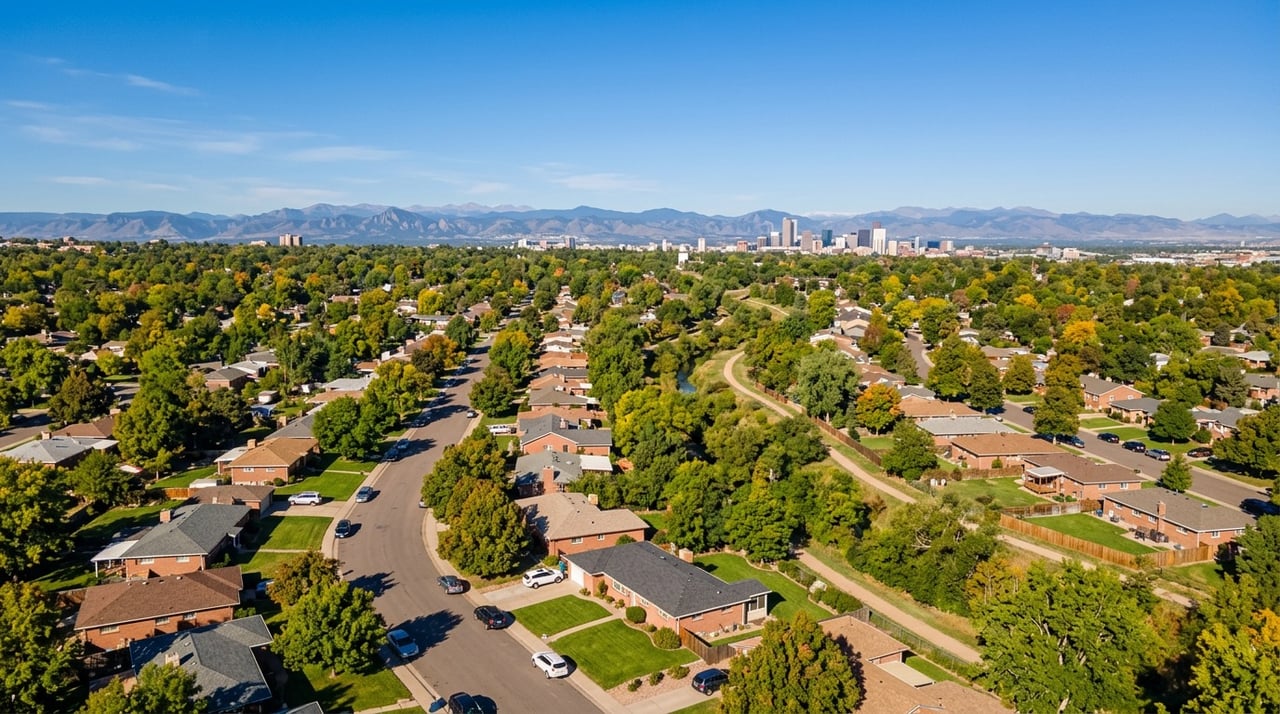
Holly Hills sits near the Yale Avenue, Colorado Boulevard, and I-25 corridor. That location is a major part of its appeal. It offers practical access north toward central Denver and Cherry Creek, south toward the Denver Tech Center, and east or west through major southeast Denver routes. At the same time, its interior streets can feel more tucked away and residential than the surrounding arterial roads suggest.
Virginia Village covers a larger and more varied area of southeast Denver. Its location between major roads such as Evans Avenue, Colorado Boulevard, Quebec Street, Monaco Parkway, and I-25 creates strong access, but it also means the neighborhood experience can change meaningfully from one block to the next.
Neither neighborhood is a “walk everywhere” Denver neighborhood in the way that Berkeley, Highland, LoHi, Capitol Hill, or Washington Park can be. Buyers here are often making a different tradeoff: more traditional homes, larger lots, more practical driving access, and a quieter day-to-day residential feel in exchange for needing the car more often.
If your lifestyle revolves around walkable restaurants, coffee shops, and a dense neighborhood retail district outside your front door, you may want to compare these areas with other options in the full Denver neighborhoods hub. If you care more about access, yards, garages, mid-century homes, trails, parks, and living in an established residential setting within the city, Holly Hills and Virginia Village should both be on your list.
The Homes: This Is Where Buyers Will Notice a Difference
Both neighborhoods have meaningful mid-century housing stock, and that is a major part of why buyers like them. You will see brick ranches, mature landscaping, homes built in the 1950s and 1960s, basements, additions, garages, original-condition properties, thoughtful remodels, and everything in between.
But the housing experience is not identical.
Holly Hills Homes
Holly Hills is more strongly defined by a cohesive collection of classic mid-century ranch homes. The streetscape tends to feel consistent, with brick exteriors, single-story layouts, mature trees, larger yards, and homes that have been owned and maintained by the same households for long periods.
That consistency is part of the appeal. Buyers often like that Holly Hills feels less pieced together than some larger Denver neighborhoods where a 1950s ranch, a large new build, an apartment complex, a townhome project, and a commercial strip may all sit within a few blocks of each other.
You will still find variety in Holly Hills. Some homes remain close to original condition. Some have been lightly updated. Others have been fully remodeled, expanded, reconfigured, or transformed into much larger homes. The difference is that the core housing identity remains very clear: established mid-century single-family homes on lots that often provide more breathing room than buyers find closer to Denver’s core.
For a deeper look at current housing, parks, access, and what buyers should expect, visit my Holly Hills neighborhood and real estate guide.
Virginia Village Homes
Virginia Village also has a strong mid-century identity, but it gives buyers more variation.
You may find classic ranches, split-level homes, homes that have been partially updated, fully renovated properties, attached homes, condos, townhomes, and a wider range of lot sizes and condition levels. That variety can be a major advantage if you are trying to balance budget, location, property type, and your willingness to take on projects.
For some buyers, Virginia Village creates more opportunities to find a house they can personalize over time. For others, it creates more decisions. You need to understand whether you are comparing an original ranch to a renovated ranch, a house with a basement to a home without one, an interior block to a higher-traffic location, or a detached home to an attached property with HOA dues.
Explore the housing mix, lifestyle, and current neighborhood context in my Virginia Village neighborhood guide.
What Does Your Money Buy in Each Neighborhood?
This is the question buyers actually care about.
Not, “What is the median home price?”
The more useful question is: At roughly the same budget, what am I likely to gain or give up by choosing Holly Hills instead of Virginia Village?
Your current price range, monthly-payment comfort level, down payment, financing structure, need for a garage or basement, willingness to update, and tolerance for road exposure or smaller lots will all shape the answer.
As a general planning framework, Holly Hills has typically carried a higher price point for detached homes. The Holly Hills neighborhood page currently places its 2026 median around $775,000, with classic ranches commonly around $700,000 to $850,000 and more comprehensively renovated or expanded homes at $950,000 and above. Virginia Village has historically offered a broader price range, with its page citing a mid-2025 median around $635,000, smaller condos beginning in the $300,000s, and renovated single-family homes reaching well into the $800,000s.
Those numbers are not a promise of current inventory or an apples-to-apples monthly comparison. They come from different timeframes, property types, and market conditions. The actual house matters more than a neighborhood median. Use current listings and recently sold comparable homes to understand what your budget can truly buy on the week you are shopping.
Budget or Priority | What Holly Hills May Offer | What Virginia Village May Offer |
|---|---|---|
Under $500,000 | Detached-home options are likely to be limited, and buyers may need to be flexible on condition, size, property type, or timing. | May offer more potential entry points through condos, townhomes, smaller homes, or properties that need meaningful updating. |
Roughly $600,000 to $750,000 | May require tradeoffs involving condition, updates, location, lot, garage, basement finish, or road exposure. | Often creates a broader range of possibilities, including mid-century homes in varied condition, though turnkey single-family homes can exceed this range. |
Roughly $750,000 to $900,000 | More realistic for classic ranches, stronger lots, interior locations, garages, finished basements, and some updated homes, depending on the exact property. | Can create strong options among updated ranches, larger homes, better lots, and a wider variety of housing styles and conditions. |
$900,000 and above | Opens more opportunities for comprehensively renovated, expanded, or higher-end Holly Hills homes. | Opens higher-end renovated and larger single-family options, but buyers should still compare whether they are paying for house quality, lot, location, or simply the neighborhood label. |
Buyer who wants a condo or townhome | Less likely to be the natural first search area because Holly Hills is primarily a detached-home neighborhood. | More likely to offer attached-home options, though HOA dues, insurance, reserves, and monthly-payment structure need to be evaluated carefully. |
The best strategy is not to decide that one neighborhood is “more affordable” and stop there. Compare actual homes side by side. A $725,000 Holly Hills ranch with a usable basement, garage, larger yard, and quieter location may compete very differently against a $725,000 Virginia Village home that is more updated but has a smaller lot, a busier location, or no garage.
Likewise, a Virginia Village home that needs cosmetic work may be the better opportunity if it has a strong location, solid systems, good lot, functional layout, and a price that reflects the updates you will eventually want to make.
What It Actually Feels Like to Live in Holly Hills
Holly Hills feels established, residential, and more cohesive than many parts of southeast Denver.
That does not mean every block is identical. It means the neighborhood has a more consistent identity: classic mid-century homes, mature landscaping, lower through-traffic on interior streets, homes with long-term ownership histories, and a quieter pace than buyers often expect given how close the neighborhood is to I-25, Yale Avenue, and Colorado Boulevard.
For buyers who are tired of seeing narrow lots, dense redevelopment, and homes packed tightly together, Holly Hills can feel like a reset. The lots often provide more usable outdoor space. The ranches can offer practical single-level living. Basements may create flexibility for guest rooms, offices, workout space, storage, media rooms, or a second living area. Garages and driveways can make everyday life easier than in denser, more central neighborhoods.
The tradeoff is that Holly Hills is not a restaurant district. You are close to shopping, services, parks, and major corridors, but most errands involve getting in the car. Buyers who want to walk to coffee, dinner, and nightlife every night may find the neighborhood too quiet. Buyers who want to come home to a calmer residential street may see that as exactly the point.
Outdoor access is a real part of the draw. Holly Hills Park, Cook Park, and the High Line Canal Trail give residents nearby places to walk, run, bike, take the dog out, or simply get outside without driving across town.
For many buyers, the Holly Hills decision comes down to this: Do you want a classic house in a quieter, more consistently residential pocket of southeast Denver, and are you comfortable paying more for that combination when the right home comes up?
What It Actually Feels Like to Live in Virginia Village
Virginia Village feels broader, more varied, and more flexible by budget and property type.
It still has the leafy streets and mid-century homes that attract buyers to this part of Denver, but it does not have quite the same level of uniformity as Holly Hills. That can be a downside for a buyer who wants a highly cohesive neighborhood experience. It can also be a major advantage for a buyer who wants more options.
Virginia Village can work well for first-time buyers, move-up buyers, buyers who want a project, buyers who need an attached-home option, and people who want southeast Denver convenience without paying the premium associated with some nearby higher-cost neighborhoods.
Daily life is still largely car-oriented, but proximity to Evans Avenue, Colorado Boulevard, Quebec Street, I-25, and other major routes can make errands, commuting, shopping, and getting around the city straightforward. The area also benefits from access to parks such as Cook Park, Ash Grove Park, and Garland Park, plus connections toward the Cherry Creek Trail.
The important caution is that Virginia Village varies more by micro-location. One home may be on a quiet interior block with a great lot and strong neighborhood feel. Another may be closer to a busier corridor, commercial use, a high-traffic cut-through, or an attached-home community with a very different ownership experience.
That does not make Virginia Village less desirable. It means buyers need to evaluate the exact house and block carefully rather than buying based on the neighborhood name alone.
Commute and Getting Around: DTC, Cherry Creek, and Downtown
Both Holly Hills and Virginia Village appeal to buyers who want practical access to multiple parts of the metro area without living directly in the center of Denver.
Holly Hills often works well for commuters heading south toward the Denver Tech Center because of access to I-25 and southeast Denver routes. It can also be convenient for people who need to get toward Cherry Creek, the University of Denver area, downtown, or central Denver, depending on traffic and time of day.
Virginia Village also offers practical access to DTC, Cherry Creek, and central Denver, but the specific commute can vary more depending on whether you are closer to Colorado Boulevard, Quebec Street, Monaco Parkway, Evans Avenue, or I-25.
Do not make a neighborhood decision based on a generic online commute estimate. Drive the route during the time you would actually use it. Test the morning commute. Test the return trip. Notice the left turns, school traffic, highway access, construction, and whether you will be happy making that drive several times each week.
For relocation buyers in particular, this is where touring both neighborhoods is valuable. A map can show that two homes are only a few miles apart. It cannot tell you whether the route feels easy, whether the surrounding streets feel like your lifestyle, or whether you will enjoy coming home there every day.
In Both Neighborhoods, the Block Matters More Than the Zip Code
This is one of the most important things I tell buyers looking in older southeast Denver neighborhoods: do not buy a neighborhood name. Buy the actual house, on the actual block, with the actual location factors you will live with every day.
Both Holly Hills and Virginia Village have quieter interior streets and more exposed edge locations. Both are near major roads. Both can offer homes with great yards, mature landscaping, and practical access. Both can also include homes affected by traffic noise, road exposure, difficult access, commercial adjacency, limited privacy, or a location that may matter to future buyers.
Before you fall in love with a house, pay attention to:
- Whether the home is on an interior street or near a major corridor.
- Traffic noise at different times of day.
- Whether the backyard is private, usable, and comfortable.
- Parking, driveway, garage, alley, and guest-parking realities.
- What the home backs to or faces.
- Proximity to parks, trails, schools, commercial areas, and major roads.
- Whether the lot, orientation, and natural light work for your daily life.
- What a future buyer is likely to notice first.
A quieter Holly Hills interior lot may be worth more to the right buyer than a busier edge location. A well-positioned Virginia Village ranch with a great lot and functional layout may be a better long-term purchase than a more expensive house in another neighborhood with permanent drawbacks.
For a deeper explanation of how to think about location, layout, condition, and future buyer demand, read how to buy a home with good resale value.
Older Homes Mean Buyers Need to Look Beyond the Kitchen
One of the best things about both Holly Hills and Virginia Village is the housing stock. Buyers love the brick ranches, mature lots, established streets, and potential to make a mid-century home their own.
But a beautifully remodeled kitchen does not tell you what is happening behind the walls, under the ground, in the attic, or at the electrical panel.
Many homes in these neighborhoods were built in the 1950s and 1960s. That does not mean they are bad homes. It means buyers need to understand the age and history of the property they are buying.
Depending on the specific home, I would want buyers to investigate items such as:
- Sewer-line material, condition, root intrusion, and remaining life.
- Electrical-panel capacity and whether older components need further evaluation.
- Plumbing material, repairs, and signs of aging or prior leaks.
- Roof age, condition, hail history, remaining life, and insurance implications.
- HVAC age, maintenance, condition, and expected replacement timing.
- Foundation, grading, drainage, and moisture considerations.
- Basement condition, water history, and whether finished space was properly completed.
- Previous renovations, additions, permits, contractor quality, and whether work was cosmetic or comprehensive.
- Windows, insulation, attic ventilation, and energy-efficiency upgrades.
- Radon testing and mitigation, if needed.
You do not need to be scared of older homes. You need to buy them with your eyes open.
A gorgeous remodel can be a positive. It is not a substitute for understanding the sewer, roof, electrical, HVAC, plumbing, drainage, permits, and structural condition of the house. That is why it matters to work with a strong inspector and bring in additional specialists when the property calls for it.
Before you get under contract, read my Denver home inspector vetting checklist. It explains why a general inspection, sewer scope, radon test, roof evaluation, insurance review, and specialist follow-up can matter so much in established Denver housing.
If You Want a Condo or Townhome, Virginia Village May Give You More Options
This is one of the clearest differences between the two neighborhoods.
Holly Hills is primarily a detached single-family-home neighborhood. If your search is focused on a classic ranch, a larger lot, a yard, more privacy, a garage, and the flexibility that comes with owning the structure and land, Holly Hills may be more aligned with what you want.
Virginia Village is more likely to offer buyers a broader range of attached-home options, including condos and townhomes. That can be helpful for buyers who want a lower purchase price, less exterior maintenance, a lock-and-leave lifestyle, or an entry point into southeast Denver without taking on the full maintenance responsibility of an older detached home.
But lower purchase price does not automatically mean lower monthly cost.
HOA dues, insurance, reserves, special assessments, property type, taxes, and maintenance responsibilities all affect the actual cost of ownership. Before buying an attached home, understand what the HOA covers, whether the reserves are healthy, whether major repairs are coming, how dues have changed, what the master insurance policy looks like, and whether the monthly payment still makes sense after every cost is included.
For a full buyer-focused comparison, read Denver condos, townhomes, or houses: which is best for your first home?.
Should You Search Both Holly Hills and Virginia Village?
For most buyers who like one of these neighborhoods, yes.
You do not need to decide between Holly Hills and Virginia Village before you start looking. In fact, you will probably make a better decision if you initially include both in your search and compare the actual homes available.
Holly Hills inventory can be limited because the neighborhood is smaller, predominantly owner-occupied, and filled with homes that people often keep for a long time. When a strong property comes up, buyers who have been waiting specifically for Holly Hills may be ready to act.
Virginia Village’s larger footprint and more varied housing stock can create a broader set of listings across different conditions, price points, lots, and property types. That may give buyers more opportunities to find value, especially if they are willing to consider original-condition homes, homes that need cosmetic work, attached homes, or different micro-locations.
The right approach is not to be loyal to a neighborhood name. It is to compare:
- The actual home.
- The actual location.
- The lot and outdoor space.
- The garage, basement, layout, and storage.
- The condition and likely maintenance needs.
- The total monthly payment.
- The asking price relative to comparable homes.
- The future resale profile.
- How the house supports your real daily life.
A strong Holly Hills listing may be worth stretching for if it checks the boxes that matter most to you. A well-located Virginia Village home with a superior layout, garage, lot, updates, and payment may be the better buy at the same budget.
Holly Hills Is Probably the Better Fit If...
- You want a more cohesive neighborhood of classic mid-century single-family homes.
- You value quieter interior streets, mature landscaping, larger lots, and a more tucked-away residential feel.
- You are looking specifically for a brick ranch, garage, basement, yard, and longer-term single-family-home lifestyle.
- You want regular access to the High Line Canal Trail, Cook Park, Holly Hills Park, and southeast Denver convenience.
- You are comfortable with a potentially higher price point or waiting for the right home because the neighborhood’s inventory can be limited.
- You care more about a calm residential setting than being able to walk to a major restaurant or retail district.
If that sounds like you, spend time on my Holly Hills Denver neighborhood page and set up a focused search so you know when the right home comes up.
Virginia Village Is Probably the Better Fit If...
- You want more housing choices across price points, conditions, and property types.
- You are open to a mid-century ranch, split-level, condo, townhome, or a home you can update over time.
- You want southeast Denver access but do not necessarily need the more uniform housing identity of Holly Hills.
- You may be looking for an entry point that provides more flexibility on purchase price, even if you are willing to take on some cosmetic work or a different property type.
- You are comfortable evaluating block-by-block differences and are willing to compare location, traffic exposure, lot, updates, and total monthly cost carefully.
- You want practical access to parks, commercial corridors, I-25, Cherry Creek, DTC, and central Denver while keeping more options open.
If that sounds more like you, start with the Virginia Village neighborhood and real estate guide, then compare the active homes against Holly Hills rather than assuming one is automatically the better value.
Which One Would I Tell My Buyers to Choose?
I would not tell you one is universally better.
I would want to know your budget, how much house you need, where you are driving every day, whether you need a garage or yard, how much maintenance you are willing to take on, whether you are open to updates, how important a quiet interior block is to you, and what compromises you are willing to make.
Then I would probably have you tour homes in both.
Because this decision is not really about whether Holly Hills or Virginia Village wins some imaginary neighborhood contest. It is about whether the actual house you are considering fits your life, your numbers, and your long-term plans better than the alternatives.
One buyer may be happiest stretching for a well-kept Holly Hills ranch with a larger lot and a calmer street. Another may be smarter buying a Virginia Village home with a stronger layout, more updates, better payment, and room to make it their own. Another may discover that a condo or townhome in Virginia Village makes more sense than taking on an older detached home right now.
The right choice becomes much clearer when you stop comparing marketing descriptions and start comparing homes in person.
Frequently Asked Questions
Is Holly Hills actually in Denver?
Yes. Holly Hills is a southeast Denver neighborhood near Yale Avenue, Colorado Boulevard, and I-25. It offers access to central Denver, Cherry Creek, the Denver Tech Center, parks, and the High Line Canal Trail while maintaining a quieter, primarily residential feel.
Is Holly Hills more expensive than Virginia Village?
Generally, Holly Hills has often carried a higher price point for detached single-family homes, particularly for updated ranches, larger lots, garages, finished basements, and quieter interior locations. Virginia Village usually offers a broader range of entry points and property types, including some condos and townhomes. However, prices vary dramatically based on the actual home, lot, condition, updates, location, and market conditions when you are shopping.
What kinds of homes are in Holly Hills?
Holly Hills is primarily known for 1950s and 1960s brick ranch homes with mature landscaping, larger lots, yards, garages, and basements. Some homes remain close to original condition, while others have been renovated, expanded, or fully reimagined.
What kinds of homes are in Virginia Village?
Virginia Village includes mid-century ranches, split-level homes, renovated and original-condition properties, plus a wider variety of condos, townhomes, and attached options than Holly Hills. That range can create more flexibility for buyers at different budgets and with different maintenance preferences.
Which neighborhood is closer to the Denver Tech Center?
Both neighborhoods offer practical access to DTC, particularly through I-25 and southeast Denver routes. The better commute depends on your exact work location, your preferred route, traffic patterns, and where the specific house sits within Holly Hills or Virginia Village. Drive the actual route during your normal commute time before deciding.
Which neighborhood gives buyers more house for their money?
Virginia Village may offer more flexibility by budget because it has a wider variety of property types, conditions, and price points. But “more house” is not just square footage. A Holly Hills home may offer a larger lot, quieter setting, garage, basement, stronger location, or more cohesive neighborhood feel that justifies a higher price for the right buyer. Compare actual listings, monthly cost, condition, and future resale factors rather than relying only on neighborhood averages.
Should buyers consider both Holly Hills and Virginia Village when searching southeast Denver?
Yes. Buyers who like one neighborhood should usually include both in their early search, then compare the actual homes available. Holly Hills may be the better fit for buyers seeking a more cohesive single-family mid-century setting. Virginia Village may provide more property-type variety, a broader range of conditions, and potentially more accessible price points. Touring both will make the tradeoffs much clearer.
Do older homes in Holly Hills and Virginia Village need more inspection work?
Not necessarily more problems, but they do require informed due diligence. Many homes were built in the 1950s and 1960s, so buyers should pay close attention to sewer lines, plumbing, electrical, roofs, HVAC systems, drainage, foundations, insulation, prior renovations, permits, and radon. A general home inspection is important, and additional evaluations such as sewer scopes, roof reviews, radon testing, or specialist opinions may be appropriate depending on the home.
Ready to Compare Holly Hills and Virginia Village in Person?
If you are deciding between Holly Hills, Virginia Village, or another southeast Denver neighborhood, I can help you build a search around what actually matters: budget, monthly payment, commute, property type, condition, yard, garage, layout, future resale, and the compromises you are genuinely comfortable making.
You do not need to pick a neighborhood from a map before you start. We can compare real homes, real blocks, real tradeoffs, and real numbers so you do not end up stretching for the wrong house or passing on the right one because you were focused on the wrong details.
Start by exploring homes and life in Holly Hills, review the Virginia Village neighborhood guide, and browse the full Denver neighborhoods guide. When you are ready to see how your budget translates into actual homes, reach out to Sallie Simmons and we will make a plan that fits your life.