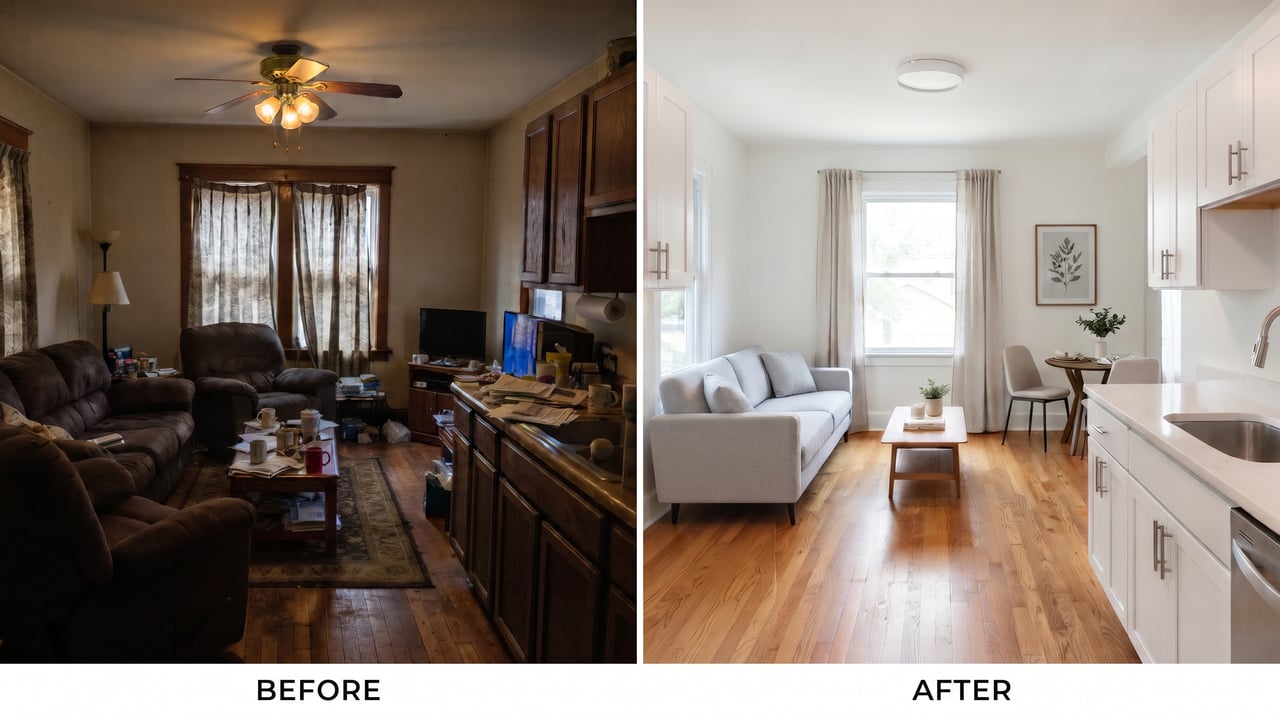
A broken microwave handle can make buyers question an entire house. Ugly paint can make a perfectly good home feel overwhelming. Here is how to tell the difference between a handyman fix, a cosmetic distraction, a major home problem, and a reason to walk away.
There is a strange contradiction I see all the time.
Sellers will spend thousands of dollars fixing things buyers may barely notice while ignoring a broken microwave handle they have been living with for three years.
Buyers will walk into a perfectly good house, see ugly paint, dated light fixtures, bad furniture, a dripping faucet, and a few burned-out bulbs, then mentally add $40,000 worth of “work” before they have even made it to the kitchen.
Both sides benefit from understanding what is actually wrong, what it costs to fix, and how much it affects the way a house feels.
Some small problems look expensive when you do not know what you are looking at. Some expensive problems look small until you know what you are looking at.
That is why knowing the difference matters whether you are buying or selling.
In a market where buyers can compare more homes, the details matter. Buyers may forgive ugly paint, dated fixtures, or an awkward couch if the house is otherwise clean, well maintained, functional, and priced correctly. But when the same house has a broken fixture, a running toilet, inconsistent lighting, visible deferred maintenance, clutter, and a price that assumes perfection, buyers start wondering whether there are better options down the street.
That is part of why even good homes are sitting in Denver right now. A home does not need to have one catastrophic problem to make buyers hesitate. Sometimes it is a collection of smaller things that creates the feeling that the house has not been cared for.
Not Every Problem Deserves the Same Reaction
The goal is not to pretend every issue is minor.
Some problems deserve a contractor. Some deserve a specialist. Some deserve a negotiation. Some deserve walking away. And some just need a new microwave handle.
Buyers need to avoid rejecting the right house because someone else did a poor job preparing it for sale. Sellers need to avoid giving buyers unnecessary reasons to doubt a house that is otherwise in good shape.
The first step is putting each issue into the right category.
The Three Kinds of Problems You See in a House
When I walk through a home with buyers or help sellers prepare a property for the market, I am usually sorting concerns into three broad categories.
1. Easy and Inexpensive to Change
These are the items that may look bad, create a negative first impression, or make a buyer wonder what else has been neglected, but they are often manageable with a handyman, a trip to the hardware store, basic cleaning, or a small amount of targeted work.
- Paint colors that are not your taste.
- Dated or mismatched light fixtures.
- Burned-out light bulbs.
- Inconsistent bulb color temperatures from room to room.
- Loose cabinet hardware.
- Minor faucet drips.
- Peeling or discolored caulk.
- Damaged window screens.
- Broken blinds.
- Closet systems that do not maximize storage.
- Overgrown landscaping.
- A broken appliance handle.
- A loose doorknob.
- A closet door that has come off its track.
- A running toilet that needs a straightforward repair.
- Missing outlet or switch covers.
- Minor drywall damage, scuffs, or nail holes.
For sellers, the question is: Is this something inexpensive I can eliminate as an objection before buyers ever see it?
For buyers, the question is: Am I rejecting this house because of something I could change easily?
2. Fixable, but Potentially Expensive
These are issues that may be manageable, but they deserve more thought, more accurate pricing, and sometimes a professional estimate before you decide how much they matter.
- Flooring throughout a large portion of the house.
- A dated kitchen or bathroom that needs more than surface-level changes.
- Windows near the end of their useful life.
- A major HVAC replacement.
- Roofing work.
- Significant landscaping, drainage, fencing, or retaining-wall work.
- Electrical or plumbing updates.
- Basement finishing or reconfiguration.
- Layout modifications that may require removing walls, relocating plumbing, or structural review.
- Old appliances that are still functioning but approaching replacement age.
This is where buyers should stop guessing. A dated kitchen does not automatically mean a $100,000 renovation. But it also may not be a simple weekend project if the layout, electrical, plumbing, flooring, cabinets, counters, and appliances all need attention.
Sellers should not automatically renovate every older room before listing, either. The right answer may be targeted repairs, cleaning, paint, better lighting, pricing, or a buyer concession rather than a full remodel. My 30-day Denver home seller prep plan explains how to prioritize must-do repairs, nice-to-do updates, and projects that are usually better skipped.
3. Difficult or Impossible to Change
These are the issues that need a different type of conversation because they are not handyman fixes and may not be renovation fixes at all.
- A busy street or highway proximity.
- A difficult lot, poor privacy, or limited usable outdoor space.
- Commercial, industrial, or high-traffic adjacency.
- A fundamentally awkward floor plan.
- Very low ceiling heights.
- Poor natural light caused by the home’s orientation or surrounding structures.
- Limited parking or difficult access.
- A permanent location issue.
- A home that does not compete well with nearby alternatives at the same price point.
Those items are not necessarily dealbreakers. But they are usually resale, pricing, lifestyle, and negotiation issues, not repair issues. For the deeper framework, read how to buy a home with good resale value.
Sellers: You Have Stopped Seeing the Little Things. Buyers Have Not.
Living in a house changes your perception of it.
You automatically lift the cabinet door a little when you close it.
You know exactly which way to jiggle the toilet handle.
You know the microwave works even though the handle is broken.
You stopped noticing that one bedroom has bright-white bulbs, the hallway is yellow, and the kitchen has three different shades of light.
You know the back door needs an extra shove.
You know which blind is broken, which closet door sticks, which exterior light only works sometimes, and which faucet you have been meaning to fix since last summer.
Buyers do not know any of that.
They are not necessarily thinking, “That microwave probably needs a $50 part.”
They are thinking, “What else have these sellers just been living with?”
Buyers do not know whether the broken microwave handle is the only thing you have been living with. That is the problem.
One small issue usually will not kill a sale. But visible little issues can make buyers feel less confident, less emotionally connected to the house, and more likely to assume they will uncover more during inspection.
That is especially true when buyers already have options. If a competing home feels cleaner, better maintained, and easier to move into, buyers may choose it even if your home technically has more square footage or a better price.
Small Visible Neglect Creates Questions About Invisible Maintenance
One broken item is not necessarily a big deal.
But five little broken things can change a buyer’s perception of the entire house.
A dirty furnace filter may cost very little to replace. But buyers may wonder whether the HVAC system has been maintained.
A dripping faucet may be an easy repair. But water makes people nervous.
A light that does not turn on may just need a bulb. The buyer does not know that.
A loose railing may be a simple tightening job. The buyer may wonder whether the deck is unsafe.
A cabinet hinge that needs adjustment may be a 10-minute repair. The buyer may start questioning the quality of the kitchen renovation.
Broken blinds, peeling caulk, damaged screens, sticking doors, loose handles, dirty grout, running toilets, dead exterior lights, and missing outlet covers can collectively create the impression of deferred maintenance.
You do not want buyers mentally writing an inspection report while they are trying to decide whether they can picture themselves living in your house.
National Association of REALTORS® reporting has noted that even relatively small showing problems can turn buyers off, particularly when clutter, visible neglect, or weak presentation makes it harder for them to understand the home’s potential. Small showing issues can cost sellers offers.
Sellers: Do a “What Have I Learned to Live With?” Walkthrough
Before listing, walk through your house as if you have never been there before.
Do not ask, “Does this bother me?”
Ask, “Would someone seeing my house for the first time think this is broken?”
Then do the following:
- Open every door.
- Open every cabinet and drawer.
- Turn on every light.
- Replace burned-out bulbs.
- Run every faucet.
- Flush every toilet.
- Open the microwave, oven, refrigerator, and dishwasher.
- Test burners and appliance functions that buyers may reasonably try.
- Check handles, knobs, latches, and hinges.
- Look under sinks for drips or staining.
- Test blinds, windows, screens, and closet doors.
- Look at outlet and switch covers.
- Walk around the exterior.
- Check exterior lights.
- Look for loose railing, peeling paint, damaged trim, or broken fencing.
- Check the furnace filter.
- Look for visible drips, loose hardware, peeling caulk, and minor repairs you have learned to ignore.
You do not need to turn this into a six-month renovation project. You need to identify the inexpensive, visible, confidence-killing things that can be addressed before buyers walk through the front door.
If you want a room-by-room seller-prep sequence, including decluttering, repairs, cleaning, staging, photos, and launch strategy, use my step-by-step 30-day plan to prepare a Denver home for sale.
Make the Lighting Consistent Throughout the House
Lighting is one of the cheapest ways to make a house feel more intentional, more current, and better maintained.
Warm or cool light is ultimately a preference. What is distracting is walking from a warm yellow kitchen into a blue-white hallway and then into a bedroom with three different bulbs in the same fixture.
Before listing, pick a color temperature that works with the home and use it consistently throughout the main living spaces.
Then make sure:
- Every fixture has working bulbs.
- Bulbs in the same room match.
- Dark rooms are bright enough to show their size and function.
- Lamps are used where they add warmth or improve a darker corner.
- Broken fixtures are repaired or replaced.
- Visible, dated fixtures are evaluated for an inexpensive update.
And yes, replace the boob lights.
They are inexpensive. There are countless better-looking replacements. And changing them can make a surprisingly large visual difference in a hallway, bedroom, entry, or dining area.
A buyer may not be able to name exactly why a home feels more polished. Consistent lighting is often part of the answer.
Fix the Cheap Things That Look Expensive
This is where sellers can often get the best return on effort.
The following issues are not always expensive, but they can look expensive when a buyer does not know the cause or repair scope:
- A broken microwave handle.
- A leaking faucet.
- A running toilet.
- A loose railing.
- A cabinet door hanging off its hinge.
- A closet door that is off its track.
- A broken switch or outlet cover.
- Peeling caulk around a tub or shower.
- A broken window screen.
- A loose doorknob.
- A dead light fixture.
- Minor drywall damage.
- Small areas of peeling exterior paint.
- A loose or missing piece of trim.
- A front door that sticks or does not latch correctly.
For sellers, the advice is simple: eliminate the question when the repair is inexpensive and obvious.
For buyers, the advice is also simple: investigate before assuming. A visible issue may be a quick repair, a larger problem, or something that needs a professional opinion. Do not make the diagnosis from a 15-minute showing.
The Cheapest Improvement Might Be Removing Something
Sometimes you do not need to buy anything.
You need to get some stuff out of the house.
Too much furniture can make a large room feel small. Heavy curtains can block natural light. Oversized sectionals can make buyers think the living room has no usable layout. Countertop clutter can make a kitchen feel short on storage. Old shelving, random DIY additions, unnecessary window treatments, excessive decor, and crowded closets can make a home feel more complicated than it really is.
Before you spend money on new furniture, expensive staging, or cosmetic renovations, try removing what is getting in the way of the house itself.
For sellers, consider removing or reducing:
- Oversized furniture.
- Heavy curtains that block windows.
- Extra chairs, side tables, and storage pieces.
- Overgrown landscaping.
- Excessive decor.
- Old shelving that makes a room feel cluttered.
- Broken accessories and unnecessary window treatments.
- Random DIY additions that no longer serve a purpose.
- Items crowding countertops, bathroom vanities, and the refrigerator.
For buyers, this is a reminder to mentally remove the seller’s possessions before deciding how a house actually lives. A seller’s giant sectional does not necessarily mean the room is small. A crowded bedroom does not necessarily mean a bed will not fit. An overfilled kitchen does not necessarily mean there is no storage.
Make Awkward Spaces Make Sense
Buyers should not have to stand in a room and ask, “What the hell is this supposed to be?”
If a room is unusual, small, narrow, disconnected, or flexible, sellers should give it an obvious purpose.
That might mean presenting it as a:
- Home office.
- Workout area.
- Reading nook.
- Drop zone.
- Playroom.
- Dining area.
- Guest space.
- Hobby room.
- Homework area.
- Pet station.
You are not trying to trick anyone. You are helping buyers understand the potential of a space that may otherwise feel confusing.
Buyers should also remember that the seller’s use is not the only possible use. Furniture placement can change a room. A closet system can solve a storage issue. An unused corner may become a work area, a reading spot, or a practical drop zone.
But staging cannot solve a fundamentally bad floor plan. If the room does not work because of ceiling height, access, layout, plumbing, structural limitations, or an unavoidable design flaw, it should be evaluated honestly as a functionality and resale issue, not dismissed as a furniture problem.
Small Outdoor Improvements Can Change How a House Lives
Not every seller needs to spend $40,000 on landscaping before listing.
But most outdoor spaces benefit from a cleanup and a clear purpose.
Before listing, consider:
- Trimming overgrown landscaping.
- Repairing broken fencing or gates.
- Cleaning the patio, deck, porch, and front entry.
- Creating a defined seating area.
- Improving privacy where it can be reasonably improved.
- Adding functional exterior lighting.
- Removing dead plants, broken pots, unused furniture, and yard clutter.
- Making the entrance feel maintained and easy to approach.
- Showing buyers how a smaller yard can still be used well.
An ugly yard can often be changed. An unusable lot may be a different story.
For buyers, that distinction matters. Landscaping, furniture, outdoor lighting, fencing, and cleanup can often improve the experience of a property. A steep lot, poor drainage, lack of privacy, no functional outdoor space, or a permanent location issue requires a more serious conversation.
Buyers: Do Not Turn a $200 Problem Into a $20,000 Problem in Your Head
A house can feel like it “needs so much work” when what a buyer actually dislikes is a combination of paint, lighting, hardware, furniture, decor, dirty grout, ugly curtains, clutter, and neglected small repairs.
Those things add up visually much faster than they necessarily add up financially.
Before rejecting a home, ask yourself:
- What do I actually need to change?
- What would each item realistically cost?
- What needs to happen before I move in?
- What could wait a year?
- What would I stop caring about after living here for two weeks?
- What is actually wrong versus merely not my taste?
- Is the house fundamentally strong even if it is not currently pretty?
Do not let someone else’s bad paint color make you miss a house with the location, layout, lot, and price that you have been looking for.
At the same time, do not use “we can change it” as an excuse to overlook a serious problem. The goal is not to minimize concerns. The goal is to price them correctly and understand whether they are cosmetic, repairable, expensive, or permanent.
This is part of buying a Denver home without overpaying. A smart buyer does not just compete well. A smart buyer understands what they are buying, what they may need to spend, what should affect the offer, and what can become an opportunity because other buyers are distracted by the wrong things.
Turn “It Needs So Much Work” Into a Real List
When you tour a house that feels overwhelming, make a real list rather than one large mental category called “work.”
Category | Examples | What to Do |
|---|---|---|
Must address before move-in | Active leak, unsafe railing, non-functioning heat, exposed electrical concern, major drainage issue, significant roof concern | Investigate, get the appropriate professional opinion, estimate the cost, negotiate, or reconsider the purchase. |
Worth doing soon | Paint, lighting, hardware, closet systems, landscaping cleanup, minor repairs, updating a faucet or fixtures | Get rough pricing, prioritize the work, and create a first-90-days plan. |
Can wait | Dated vanity, ugly curtains, old backsplash, decorative finishes, furniture changes, cosmetic preferences | Live with the home first. Decide what still matters after you understand how you use the space. |
That exercise can keep a buyer from walking away from a good house for the wrong reason. It can also keep a buyer from underestimating the cost of a true condition issue.
Ugly Is Different From Dysfunctional
Ugly kitchen cabinets that work are not the same thing as a dysfunctional kitchen.
Bad paint is not the same thing as bad walls.
Ugly landscaping is not the same thing as an unusable lot.
A dated bathroom is not automatically failing plumbing.
Old light fixtures are not automatically an electrical problem.
A seller’s giant sectional making a room look tiny does not automatically mean the room is tiny.
But do not swing too far in the other direction.
A genuinely dysfunctional kitchen, unusable lot, serious drainage issue, major system problem, active water issue, or fundamentally bad layout does not become “cosmetic” just because somebody wants the house.
This is where judgment matters.
Buyers should understand what Denver buyers want in 2026, because functional space, move-in-ready condition, usable outdoor areas, and a home that feels well maintained tend to matter when people are comparing multiple options. Sellers should understand the same thing because the market does not reward them for money spent on random upgrades. It rewards homes that feel clean, functional, cared for, and appropriately priced.
When a Small Problem Needs a Professional Opinion
A broken microwave handle is not a reason to walk away.
Water where water should not be, structural concerns, electrical issues, and major system failures are not “just cosmetic.” That is when you stop guessing and bring in the right professional.
Buyers and sellers should seek a qualified professional opinion when they encounter things such as:
- Active or recurring water intrusion.
- Water stains, musty odors, mold-like growth, or soft drywall.
- Large cracks, evidence of movement, or doors and windows that may indicate a broader structural concern.
- Exposed wiring, non-functioning outlets, electrical-panel concerns, or other electrical questions.
- Gas odors, combustion concerns, chimney issues, or unsafe appliances.
- Sewer backups, slow drains throughout the house, or signs of a sewer-line issue.
- A roof near the end of its useful life, active roof leaks, or insurance-related questions.
- HVAC equipment that is not heating or cooling reliably.
- Drainage, grading, foundation, or retaining-wall concerns.
- Unpermitted additions, basement finishes, or structural modifications.
A handyman may be appropriate for minor repairs. Plumbing, electrical, HVAC, roofing, structural, permitting, drainage, sewer, or safety questions may require a licensed specialist or the appropriate professional evaluation.
Do not let fear turn every small repair into a disaster. But do not let optimism turn a real issue into a casual DIY project, either.
A Showing Is Not an Inspection
A showing is where buyers identify questions. It is not where buyers diagnose the entire property.
During a showing, a buyer can notice that a faucet drips, a room feels dark, a door sticks, the furnace filter looks dirty, or a bathroom appears dated. Those observations are useful. They help determine whether the house deserves a closer look and whether the offer should account for visible condition.
But a buyer should not assume the cause, scope, cost, or seriousness of every issue without an inspection or the right professional evaluation.
Likewise, sellers should remove small visible distractions before showings, but they should not conceal known defects or try to put a cosmetic Band-Aid over a problem that needs a real solution, disclosure, estimate, or pricing adjustment.
Home inspections often identify a long list of aging components, maintenance suggestions, minor defects, and observations. That does not mean every item deserves a repair request or creates a reason to cancel a contract. Buyers should prioritize genuine safety issues, major systems, material defects, functionality, and likely costs rather than treating every line in an inspection report as equally urgent.
If you are buying, read my guide to choosing a reliable home inspector in Denver before your inspection deadline. A strong inspector helps you understand condition, but the right next step may also include a plumber, electrician, roofer, HVAC professional, sewer-scope company, structural engineer, or contractor depending on the concern.
Sellers: Do Not Renovate the House When You Could Remove the Objections
You do not necessarily need a new kitchen before listing.
You might need fresh caulk, working lights, consistent bulbs, a repaired microwave handle, a new faucet, clean landscaping, a serviced furnace, a fresh filter, functioning doors, better fixtures, some paint, and less furniture.
Spend money intentionally.
If $2,500 worth of targeted work removes 10 little objections, that may be far more useful than spending $25,000 remodeling something the next owner might change anyway.
Before you spend money, ask four questions:
- Will a buyer notice this in photos or during the first showing?
- Will it create doubt about maintenance, safety, condition, or functionality?
- Can it be fixed for a relatively small amount of money?
- Will the likely buyer want something different anyway?
If buyers will notice it, it creates doubt, and it is inexpensive to fix, fix it.
If it is a major upgrade driven mostly by your personal taste, pause before spending.
If it is a true defect, a safety issue, or a major system concern, investigate it before deciding whether to repair it, disclose it, gather contractor estimates, price around it, offer a concession, or adjust your strategy another way.
In a more balanced market, sellers generally have three big levers: price, condition, and terms. If you want a deeper explanation of when a price adjustment, seller concession, or rate buydown may make more sense than an unnecessary renovation, read price drops versus seller perks in the Denver market.
Buyers: Do Not Reject a Good House Because Someone Else Did Not Prepare It Well
Sometimes a seller did a poor job preparing the house.
That can create opportunity.
If other buyers are distracted by ugly paint, terrible furniture, boob lights, bad landscaping, clutter, dated hardware, and a broken microwave handle, you may be looking at a fundamentally stronger house with fixable problems that are suppressing competition.
That is more interesting than simply telling buyers to “look past paint.”
The real question is whether you can buy the fundamentally better house because other buyers could not see beyond the cosmetic distractions.
Maybe the home has the better lot, better location, more usable square footage, stronger layout, larger yard, or more attractive price. Maybe it simply needs paint, lighting, cleaning, basic repairs, and a plan.
That does not mean you should overlook serious defects. It means you should not confuse ugly with broken, cluttered with small, dated with dysfunctional, or a $200 repair with a $20,000 problem.
I Am Not a Home Inspector. I Am the Person Who Helps You Decide What Deserves a Closer Look.
I am not a home inspector, contractor, plumber, electrician, roofer, structural engineer, or sewer-scope company.
I am not going to walk into a house, see a water stain, and pretend I can diagnose exactly what is behind it without the right professional looking at it.
But I have been through a whole lot of inspections.
I have walked through homes with buyers who were convinced a dated fixture meant the whole house was a disaster. I have worked with sellers who were ready to spend tens of thousands of dollars renovating a room when a few targeted repairs, paint, lighting, cleaning, and removal of unnecessary furniture would have solved the buyer objections that actually mattered.
I have also seen the opposite: a seller who thought a problem was “just cosmetic” when it needed a professional opinion, or a buyer who wanted to dismiss something as minor when the issue involved water, safety, structure, drainage, electrical work, a major system, or a question that should not be answered by guessing.
I am not a home inspector. I am the experienced sounding board who helps you decide whether you are looking at a handyman fix, a cosmetic distraction, a negotiation issue, or a problem that needs a professional opinion.
For sellers, I help separate the things that are worth fixing before listing from the things that are unlikely to deliver a meaningful return. We look at what buyers will notice, what will create doubt, what can be handled with a handyman, what needs a licensed professional, what needs an inspection or contractor estimate, and what may be better handled through pricing or negotiation rather than a rushed renovation.
For buyers, I am a sounding board when a house feels overwhelming. We slow down and ask: Is this ugly, inconvenient, repairable, expensive, or actually a serious concern? Does this need a $100 fix, a $2,000 project, a specialist’s opinion, a repair request, a price adjustment, or a decision to walk away?
I am not there to talk you into ignoring a real problem. I am there to make sure you do not confuse a small problem with a major one, or a major problem with something that can be solved by replacing a faucet, changing light bulbs, repairing a door, or getting some furniture out of the room.
How We Decide What to Do Next
What We See | Likely Next Step | What It Usually Means |
|---|---|---|
Burned-out bulb, broken blind, loose handle, damaged screen, peeling caulk, minor drywall damage | Handyman repair or simple seller-prep task | Usually inexpensive, but worth fixing because buyers notice it and may assume broader neglect. |
Outdated fixtures, ugly paint, heavy curtains, crowded rooms, old furniture, cluttered counters | Cleaning, decluttering, paint, lighting, staging, or a targeted update | Often cosmetic. It may change how the house feels without changing the home itself. |
Leaking faucet, running toilet, sticking door, cabinet-hinge issue, appliance-handle problem | Investigate the scope, then repair before listing or obtain a realistic estimate | It may be simple, but buyers do not know that. Fixing the visible issue can prevent unnecessary doubt. |
Water stains, recurring leaks, drainage concerns, widespread cracks, electrical issues, roof problems, HVAC failure, sewer concerns | Professional evaluation | Do not guess. Determine the cause, scope, cost, documentation, and strategy before deciding whether to repair, disclose, negotiate, or walk away. |
Busy road, poor lot, bad layout, low ceilings, difficult access, commercial adjacency | Pricing, negotiation, or a decision not to buy | These are often permanent resale or livability factors, not handyman fixes. Read how to buy a home with good resale value for the deeper framework. |
How I Think About These Things With My Clients
Whether I am walking through a house with a buyer or preparing a seller for the market, I am usually trying to bring the temperature down.
Buyers can panic over a house that is ugly but fundamentally solid. Sellers can become overwhelmed by a long list of possible projects and assume they need to renovate everything before anyone will make an offer.
Neither reaction is usually helpful.
My job is to be a sounding board and a voice of reason. We look at what is actually in front of us, what a buyer will notice, what a seller can address efficiently, what could affect value or resale, and what needs a closer look from the right professional.
With buyers, I am asking:
- Is this ugly, inconvenient, repairable, or actually a serious problem?
- What would it realistically cost to change?
- Does it need to be handled before move-in, or can it wait?
- Does a repair solve the actual issue, or is the issue permanent?
- Is the seller asking us to pay as though the problem is already fixed?
- Will this affect my buyer’s daily life or future resale position?
- Do we need an inspector, contractor, sewer scope, roofer, electrician, plumber, or other specialist to evaluate it?
With sellers, I am asking:
- What have you stopped noticing after living here for years?
- What visible problems will cause buyers to question the home’s overall maintenance?
- What can a handyman solve quickly and affordably?
- What needs a licensed professional or a more careful evaluation?
- What should we fix before listing because it will remove an obvious objection?
- What should we leave alone because spending the money will not create a meaningful return?
- What should be addressed through honest pricing, documentation, disclosure, or negotiation rather than a rushed renovation?
That is the expertise running through both sides of a transaction. It is not about pretending every house is perfect. It is about knowing what deserves attention, what deserves a quote, what deserves a negotiation, and what deserves walking away.
The Goal Is Not a Perfect House
For buyers, the goal is not to reject the right house for the wrong reason.
For sellers, the goal is not to give buyers unnecessary reasons to reject your house.
For both sides, there is a huge difference between a home with a few things that need attention and a home with a fundamental problem.
A good real estate decision starts with knowing which one you are looking at.
Some problems deserve a contractor. Some deserve a negotiation. Some deserve walking away. And some just need a new microwave handle.
Knowing the difference can save you a lot of money.
Frequently Asked Questions
What should sellers fix before listing a house?
Sellers should usually fix inexpensive, visible issues that buyers will notice in photos or during a showing, especially problems that make the home feel neglected. Examples include dripping faucets, running toilets, burned-out bulbs, broken blinds, damaged screens, loose hardware, peeling caulk, sticking doors, dead exterior lights, and minor drywall damage. Sellers should also investigate serious safety, water, electrical, roof, HVAC, drainage, and system concerns before deciding whether to repair, disclose, price around, or negotiate them.
Should I renovate my kitchen before selling my home?
Not necessarily. A full kitchen remodel is expensive, and the next buyer may have different preferences. In many cases, cleaning, repairing visible issues, updating lighting or hardware, improving paint, addressing worn caulk, and pricing appropriately can be a better return than a major renovation. The best answer depends on the home’s price range, condition, competing listings, and the buyer expectations in your market.
Do small repairs really affect how buyers view a house?
Yes. A single small issue may not matter much, but several visible problems can make buyers question overall maintenance. Buyers do not know whether a broken handle, dripping faucet, dirty filter, or sticking door is isolated or part of a larger pattern of deferred maintenance.
What cosmetic issues should buyers look past?
Buyers should consider looking past things such as paint colors, dated light fixtures, furniture, decor, curtains, clutter, dirty grout, minor hardware issues, landscaping cleanup, and other changes that are relatively easy to make. They should not ignore active water issues, electrical concerns, structural questions, drainage problems, system failures, safety hazards, or permanent location and layout drawbacks.
How can buyers tell whether a home needs cosmetic work or major repairs?
Start by making a specific list. Separate items that need immediate attention from items that can be addressed soon and cosmetic items that can wait. During the inspection period, bring in the appropriate professionals for questions involving water, plumbing, electrical, roofing, HVAC, structure, drainage, sewer lines, or safety. Do not rely on assumptions made during a short showing.
Should sellers fix an issue or offer a buyer concession?
It depends on the issue. If a repair is inexpensive, visible, and likely to create doubt, fixing it before listing is often the better move. For larger repairs, an estimate, pricing adjustment, disclosure, or seller concession may make more sense. The right approach depends on the property, the market, buyer feedback, timing, and whether the next buyer is likely to want a different solution anyway.
Can poor staging make a good house look bad?
Absolutely. Oversized furniture, clutter, heavy curtains, poor lighting, crowded counters, and rooms without a clear purpose can make buyers misunderstand the home’s size, storage, light, and functionality. Sellers should remove distractions. Buyers should mentally separate the house itself from the seller’s belongings before deciding what the home can become.
Need a Calm, Practical Second Opinion?
If you are selling, you do not need to guess whether you should spend $500, $5,000, or $50,000 before listing. We can walk through the house, identify what buyers are likely to notice, decide which objections are inexpensive to remove, and determine what needs a professional opinion before you spend money in the wrong place.
If you are buying, you do not need to make a major financial decision based on a bad paint color, a broken handle, intimidating inspection language, or the fear that every imperfect detail means the house is a disaster. We can sort through what is cosmetic, what is repairable, what needs more information, what should affect your offer, and what should make you walk away.
If your Denver home is already on the market and not getting the response you expected, start with why your Denver home may not be selling. Often, the answer is not one huge problem. It is a strategy issue involving condition, presentation, pricing, buyer expectations, or the need to remove the objections that are getting in the way.
Reach out to Sallie Simmons when you want a straightforward sounding board, a realistic prep plan, or a buyer strategy that helps you see the difference between a minor fix and a major problem.