Roughly half of all homes in Colorado test at or above the level where the EPA recommends you take action. That is not a scary statistic pulled from a national average and applied loosely to us. It is a Colorado number, and Denver sits squarely in the highest risk category the EPA assigns.
I have written a lot about the parts of a Denver transaction that surprise people. Radon is the one that surprises them most, because it is invisible, it has nothing to do with how nice the house is, and it shows up in the middle of the inspection period when everyone is already emotionally committed. A 1912 bungalow in Baker and a 2019 build in Central Park can both test high. Price does not protect you. Age does not protect you. Only a test tells you.
Here is what you actually need to know, whether you are buying, selling, or just curious what is happening under your basement slab.
The short answer
- Radon is a naturally occurring radioactive gas that seeps up from soil and rock into homes through foundation cracks, sump pits, crawl spaces, and utility penetrations.
- The EPA action level is 4.0 pCi/L. Colorado's average indoor level is around 6.4 pCi/L, well above that threshold.
- About half of Colorado homes exceed the action level, and Denver is designated EPA Zone 1, the highest of three risk categories.
- Colorado law requires a radon disclosure in every residential sales contract, but it does not require a test. Testing is on you.
- Mitigation typically runs about $1,200 to $3,500 in the Denver metro, with most standard basements landing in the $1,900 to $2,900 range.
- Anyone you pay to test or mitigate radon in Colorado must hold a state license. You can verify that in about a minute.
That last point is the one most buyers do not know, and it is the one that separates a real mitigation system from a bad one.
Buying or selling in Denver this year and want someone who catches this stuff before it becomes a problem? Let's talk.
Why Colorado has a radon problem
Radon comes from the natural decay of uranium in soil and bedrock. The Front Range has geology rich in the source material, and our building style makes it worse. We build with basements. We build tight, well insulated homes that hold conditioned air in. Add the stack effect, where warm air rising through a house creates negative pressure at the lowest level, and your basement effectively becomes a straw pulling soil gas up through every crack and gap in the slab.
Colorado State University research puts the average indoor radon level in Colorado at roughly 6.3 to 6.4 pCi/L. The Colorado Department of Public Health and Environment found that 48.3 percent of single family homes tested between 2005 and 2022 exceeded the EPA action level. Denver Public Health puts it plainly: the EPA has ranked Denver as Zone 1, which means the average house here will likely exceed 4.0 pCi/L.
For scale, the EPA notes that living in a home at Colorado's average radon level is comparable to receiving roughly 200 chest x-rays per year, and that about 500 Coloradans die annually from radon induced lung cancer. Radon is the leading cause of lung cancer in people who have never smoked and the second leading cause overall.
Denver metro radon levels by county
Every county in Colorado carries elevated potential, but averages vary. These are reported county averages from state and aggregated testing data, useful for context and useless as a substitute for testing your specific address.
County | EPA Zone | Reported average | What it means |
|---|---|---|---|
Denver | Zone 1 | Above 4.0 pCi/L | Average home likely exceeds action level |
Arapahoe | Zone 1 | About 8.4 pCi/L | More than double the action level |
Adams | Zone 1 | About 8.0 pCi/L | Twice the action level |
Jefferson | Zone 1 | Above 4.0 pCi/L | Foothills geology, highly variable |
Douglas | Zone 1 | Above 4.0 pCi/L | Newer stock, still elevated |
Statewide, 53 of Colorado's 64 counties are classified Zone 1 and not a single one is Zone 3, the low risk category. Colorado State University Extension goes further and treats all Colorado counties as Zone 1 for practical purposes.
The variability matters more than the average. I have seen two houses on the same block, similar age and similar foundation, test at 2.1 and 11.4. Soil is not uniform. Neither are foundations, drainage, or how someone finished a basement in 1994.
What Colorado law actually requires
Two laws shape how radon shows up in a Denver transaction, and people routinely confuse what they do.
SB23-206: disclosure, not testing
Effective August 7, 2023, Senate Bill 23-206 requires every residential real estate sales contract in Colorado to include a bold faced radon warning statement. It also requires sellers to disclose any knowledge they have of the property's radon concentrations and history, including prior tests performed, reports written, and mitigation work completed. Sellers must also provide the most recent CDPHE brochure on radon in real estate transactions.
The law extends to landlords, who must give the same written disclosures to prospective tenants. If a landlord fails to provide the disclosures or fails to mitigate an elevated level, the tenant may void the lease under the implied warranty of habitability statutes, though after January 1, 2026 that remedy applies only to leases longer than one year.
Read that again: the law requires disclosure. It does not require a test. A seller who has never tested has nothing to disclose and is fully compliant. Roughly half the sellers you encounter fall into exactly that category, which means the absence of a disclosed problem tells you close to nothing.
HB21-1195: licensed professionals only
Since July 1, 2022, anyone performing radon measurement or radon mitigation for pay in Colorado must hold a state license issued through the Department of Regulatory Agencies. Colorado is one of a small number of states that regulates this. There are two credentials, Radon Measurement Professional and Radon Mitigation Professional, and licensees must be certified through the National Radon Proficiency Program or the National Radon Safety Board, pass an exam, and follow ANSI/AARST field standards.
Licenses expire every May 31. You can search the DORA license database for free, without an account, using the individual or company name. Check for active status and a current expiration date.
This is the fastest quality filter you have. If a contractor cannot produce an active Colorado radon mitigation license, walk. The same way I tell buyers to vet their inspector before they need one, covered in my home inspector vetting checklist, you vet the radon professional before you are 48 hours from an objection deadline.
How radon testing actually works
There are two categories of test, and the transaction almost always uses the first.
Short term tests
These run a minimum of 48 hours and are what you will use during an inspection period. They require closed house conditions, meaning windows and exterior doors stay shut except for normal entry and exit, and the HVAC runs normally. The device sits in the lowest livable level of the home, not in a closet, not in the laundry, not next to a window or exterior wall.
Continuous radon monitors are the professional standard because they log hour by hour readings, which lets a good technician spot tampering. Yes, tampering happens. A window cracked on hour 30 of a 48 hour test will drop the number, and a continuous monitor shows exactly when it happened.
Long term tests
These run 90 days to a year and give a far better picture of your actual annual exposure, because radon fluctuates with season, barometric pressure, snowpack, and whether your furnace is running. Winter readings in Denver tend to run higher than summer readings. Long term testing is the right tool for a homeowner deciding whether to mitigate, and the wrong tool for a buyer with a 10 day inspection objection deadline.
If you are buying and the short term result comes back at 3.8, right under the action level, that is not an all clear. That is a number worth retesting after you own the home, in winter, over a longer window.
Not sure what your inspection timeline allows? My Denver Buyer Game Plan walks through the deadlines that matter most.
Radon inside a Denver contract
Here is the sequence, practically.
- Order the radon test with your general inspection. Most Denver inspectors either hold a measurement license or subcontract to someone who does. Ask which, and ask for the license number.
- The device needs 48 hours minimum. Build that into your inspection objection deadline. This is where out of state buyers get squeezed, one of the issues I flag in the biggest mistakes out of state Denver buyers make. If you write a seven day inspection deadline, you have effectively given yourself five days.
- If the result is at or above 4.0 pCi/L, radon becomes an inspection objection item like any other.
- Negotiate the remedy. Common outcomes are the seller installs a system before closing using a licensed mitigator, the seller credits the buyer a set amount at closing, or the parties split it. In the current Denver market, with inventory at its highest level of the year and buyers holding more leverage than they have in several years, sellers are agreeing to mitigation more readily than they were in 2021.
- If a system is installed, get a post mitigation test. Not the installer's word. An actual verification test after the system has run. A properly designed system should pull levels well below 4.0, and often below 2.0.
One nuance worth knowing: mitigation is fast. A standard system is typically a one day install. It is one of the few inspection items that does not blow up a closing timeline, which is exactly why it is worth objecting on rather than waiving.
What mitigation costs in the Denver metro
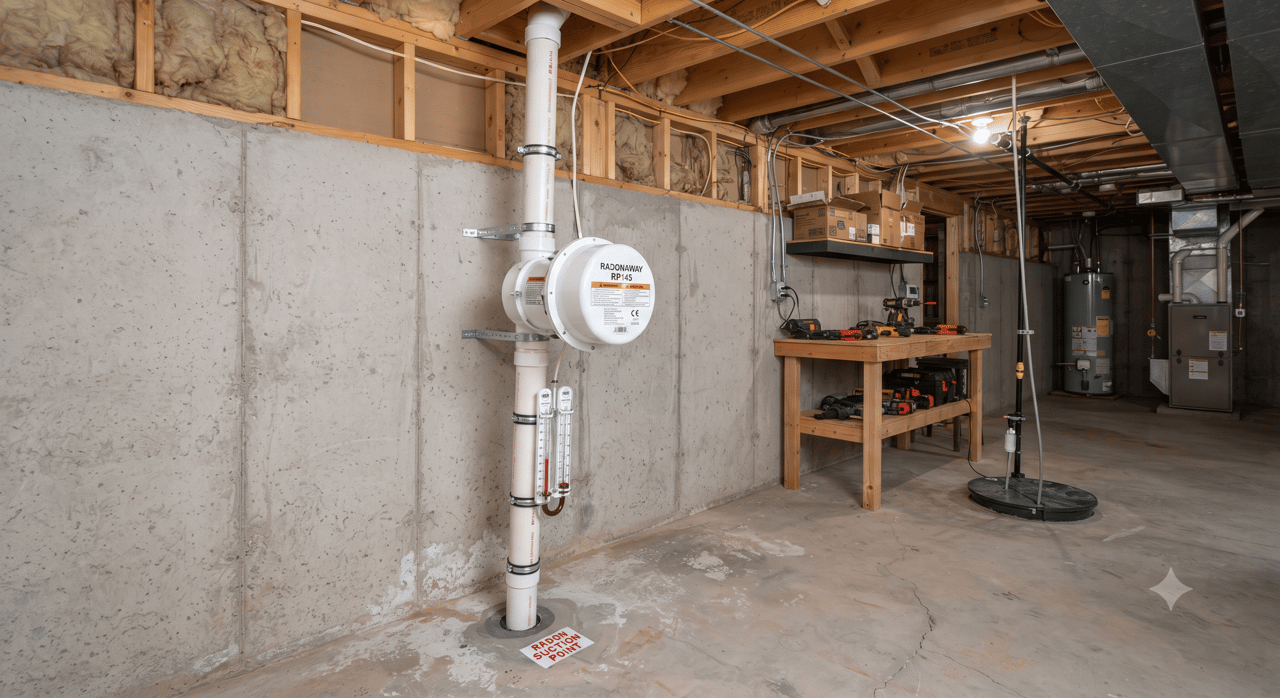
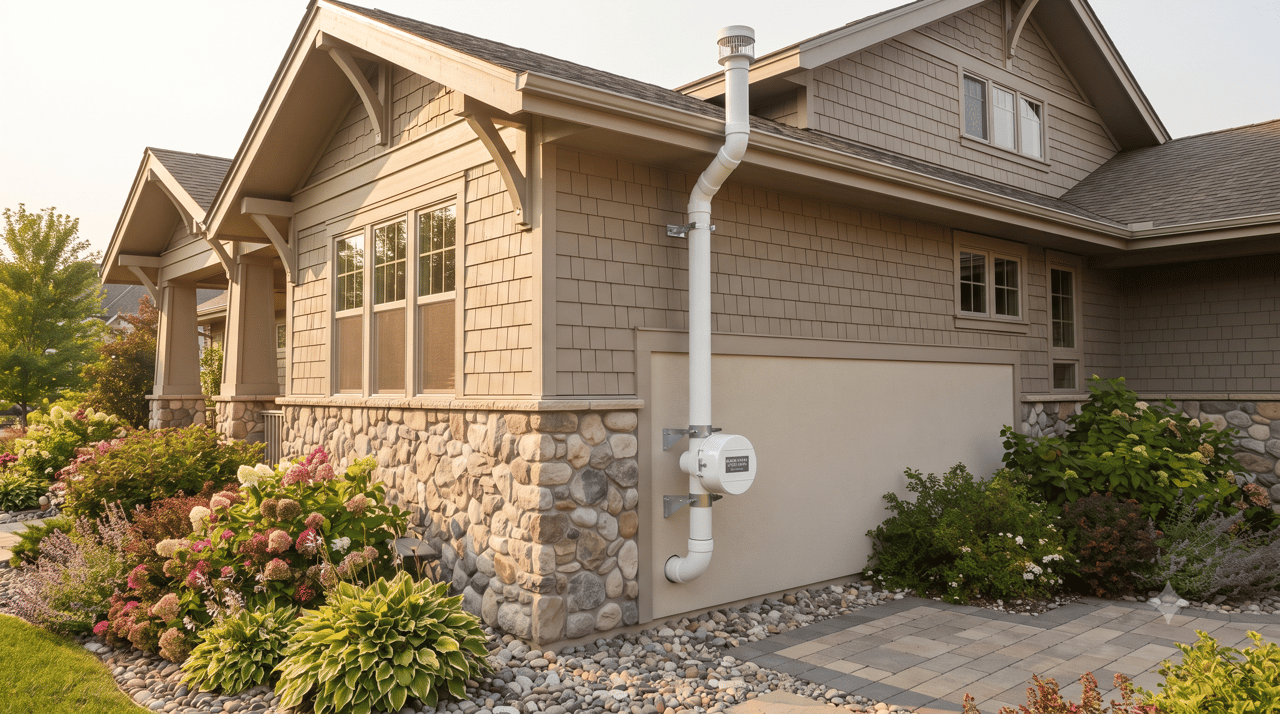
Most homes get active soil depressurization. A mitigator cores a hole through the basement slab, runs PVC piping to a fan mounted in the attic, garage, or on an exterior wall, and vents the soil gas above the roofline. The fan creates negative pressure under the slab so radon goes out the pipe instead of into your living room.
Line item | Low | Typical | High |
|---|---|---|---|
System installation | $1,200 | $1,900 | $3,500 |
Testing and post install verification | $150 | $300 | $600 |
Permits and inspections | $100 | $350 | $700 |
Materials and venting | $150 | $350 | $1,000 |
Denver area projects generally land between $1,200 and $3,500 total, with most standard basements clustering around $1,900 to $2,900. Costs climb with multiple foundation zones, crawl spaces requiring vapor barrier encapsulation, additions built on separate slabs, and homes where the only viable venting route runs through finished space.
Operating cost is minor. The fan runs continuously and typically adds a few dollars a month to your electric bill. Fans generally last around 10 years and cost a few hundred dollars to replace.
Colorado also runs a Low income Radon Mitigation Assistance program that can cover mitigation for qualifying households. Worth knowing about if you are helping a family member or working with a first time buyer on a tight budget. My rundown of Colorado down payment assistance in 2026 covers other programs in the same spirit.
If you are selling a Denver home
My recommendation is usually the same: test before you list.
Three reasons. First, you control the timeline instead of reacting to a buyer's number on day eight of the inspection period. Second, if it is elevated, you can mitigate on your schedule and shop the work rather than accepting whatever the buyer's chosen contractor quotes. Third, a documented mitigation system with a passing post install test is a genuine marketing asset. It removes an objection before it exists.
In a market where homes are sitting longer, removing friction matters more than it did two years ago. I get into that logic in more depth in why homes are not selling in Denver right now and in the 30 day pre listing prep plan.
One caution. Once you test, you know, and once you know, you must disclose under SB23-206. Some sellers hear that and decide not to test. I understand the instinct and I think it is a mistake. A buyer is going to test anyway, and finding out at objection time costs you negotiating position and sometimes the deal.
Thinking about listing? Start with a real number on your home. Get your home valuation here or grab the Smart Seller Game Plan.
Situations that trip people up
New construction with a passive system
Many newer Denver metro builds include a passive radon system, which is piping and a sealed slab but no fan. Passive systems reduce radon. They frequently do not reduce it below 4.0. If you are buying new construction, test it, and know that activating a passive system by adding a fan is usually cheap because the piping already exists. This is one of the things I tell buyers comparing a new build against a classic Denver charmer.
Condos, townhomes, and garden levels
Ground floor and garden level units in contact with soil can absolutely test high. Upper floor units are generally low risk. Mitigating an individual unit in a shared building gets complicated fast, because the fix may touch common elements and require HOA approval. Ask about it before you are under contract. Related reading on the attached market is in my piece on Denver condos and resale value.
Finished basements
Denver has an enormous stock of homes with basements finished at some point in the last 40 years, often without permits. A finished basement means more time spent at the level with the highest concentration, and it can complicate venting routes. It also frequently hides the slab penetrations and sump pits that are the entry points. You will find plenty of this in Harvey Park, Virginia Village, University Hills, and other mid century pockets.
Rentals and ADUs
If you own rental property, SB23-206 disclosure obligations apply to you as a landlord, and the tenant remedy provisions have teeth. If you are adding an ADU under Denver's ADU policy, radon resistant construction is far cheaper to build in than to retrofit.
Three myths worth killing
"My neighbor tested fine, so I am fine." Radon varies house to house on the same street. Soil composition, foundation condition, and drainage all differ. Your neighbor's number is trivia.
"It is a new house, so it is fine." Tighter construction can concentrate radon rather than dilute it. Newer homes test high regularly.
"A mitigation system means the house has a problem." A mitigation system means the house has a solution. I would rather buy a house with a documented, verified system than an untested one.
Frequently asked questions about radon in Denver homes
Is radon testing required when buying a home in Colorado?
No. Colorado law requires a radon disclosure in every residential sales contract and requires sellers to share any radon knowledge and testing history they have, but it does not require a test to be performed. CDPHE strongly recommends that all buyers test before purchasing.
What is a dangerous radon level?
The EPA action level is 4.0 pCi/L, and mitigation is recommended at or above that number. Many homeowners also choose to mitigate between 2.0 and 4.0, since there is no level considered completely risk free. Colorado's average indoor level is around 6.4 pCi/L.
How much does radon mitigation cost in Denver?
Most Denver metro systems run about $1,200 to $3,500, with typical standard basement installations landing around $1,900 to $2,900. Costs increase with multiple foundation types, crawl spaces, and difficult venting routes.
How long does a radon test take?
A short term test used during a real estate transaction requires a minimum of 48 hours under closed house conditions. Long term tests run 90 days to a year and give a more accurate picture of annual exposure.
Who pays for radon mitigation in a Denver home sale?
It is negotiable and handled through the inspection objection and resolution process. Common outcomes are the seller installing a system before closing, a seller credit at closing, or a split. With Denver inventory at its highest level of the year, buyers currently have more leverage on this than they did in the 2021 market.
Does radon mitigation work?
Yes. A properly designed active soil depressurization system routinely brings levels well below 4.0 pCi/L, often below 2.0. Always confirm with a post mitigation verification test rather than relying on the installer's assurance.
Do radon professionals need a license in Colorado?
Yes. Since July 1, 2022, anyone performing radon measurement or mitigation for pay in Colorado must hold a state license through the Department of Regulatory Agencies. Licenses expire annually on May 31 and can be verified for free through the DORA license lookup.
Can radon affect my home's resale value?
An untested or unmitigated elevated level can cost you at the negotiating table or delay a closing. A documented mitigation system with a passing verification test is generally neutral to positive, because it removes a buyer objection before it arises.
Do new construction homes in Denver have radon problems?
They can. Many newer builds include a passive system, which reduces radon but often not below the action level. Test the home, and know that activating a passive system with a fan is usually inexpensive because the piping is already in place.
Can radon get into a condo or upper floor unit?
Ground floor and garden level units in contact with soil can test elevated. Upper floor units are generally low risk. Mitigating a unit in a shared building may involve common elements and require HOA approval, so raise it early.
Should I retest after mitigation?
Yes, and then periodically. Retest after the system is installed and running, then every two years or so, and again after any foundation work, major renovation, or HVAC replacement. Replace the fan when it fails, typically around the 10 year mark.
Is radon worse in winter in Denver?
Generally yes. Closed windows, running furnaces, and frozen or snow covered soil all push more soil gas into the home. A summer test that comes in just under 4.0 may read higher in January, which is why long term testing is the better tool for homeowners.
The bottom line
Radon is one of the cheapest problems to find and one of the cheapest to fix. A test costs a couple hundred dollars. A system costs less than most kitchen appliances packages. What makes it expensive is discovering it late, or never testing at all and living with it for 20 years.
If you are buying, put the radon test on the inspection order and give yourself the 48 hours. If you are selling, test before you list so you are negotiating from information rather than reacting to it. If you already own and have never tested, order a long term kit and be done wondering.
I have spent 13 years walking Denver buyers and sellers through the parts of a transaction nobody warns them about. Radon is high on that list. If you want a straight answer about your specific house, your specific neighborhood, or your specific timeline, reach out.
Ready to make a move in Denver? Get in touch with Sallie Simmons for a real conversation about your goals. Or start here:
- The 2026 Denver Buyer Guide
- The Denver Seller Guide
- What is my Denver home worth
- Explore Denver neighborhoods
- Relocating to Denver
- Denver Real Estate Resource Center
Sources
- Colorado Department of Public Health and Environment, "Half of Colorado homes have elevated radon levels, which can cause lung cancer": https://cdphe.colorado.gov/press-release/half-of-colorado-homes-have-elevated-radon-levels-which-can-cause-lung-cancer
- Denver Department of Public Health and Environment, Radon: https://www.denvergov.org/Government/Agencies-Departments-Offices/Agencies-Departments-Offices-Directory/Public-Health-Environment/Public-Health-Investigations/Healthy-Families-Healthy-Homes/Radon
- U.S. EPA, "Test Your Nest" Colorado radon fast facts: https://www.epa.gov/newsreleases/epa-encourages-rocky-mountain-and-great-plains-region-residents-test-your-nest-and
- Colorado Division of Real Estate, Broker Practice Advisory on SB23-206: https://dre.colorado.gov/division-notifications/broker-practice-advisory-sb23-206-and-changes-to-the-commission-approved
- Colorado General Assembly, SB23-206 Disclose Radon Information Residential Property: http://leg.colorado.gov/bills/sb23-206
- Colorado DORA Office of Radon Professionals: https://dpo.colorado.gov/RadonProfessionals
- Rocky Mountain Chapter of AARST, Colorado licensure under HB21-1195: https://rockymtn.indoorenvironments.org/Colorado-Licensure
- Colorado State University Extension Fact Sheet 9.953, Radon: https://extension.colostate.edu/docs/pubs/consumer/09953.pdf
- Vertex Engineering, Radon in Colorado regulations and CDPHE testing data: https://vertexeng.com/insights/radon-in-colorado-new-regulations-and-implications/
- University of Colorado Anschutz, Radon exposure an ongoing cancer concern for Colorado homes: https://news.cuanschutz.edu/cancer-center/radon-exposure-ongoing-cancer-concern
- Radon Resources, Colorado county radon averages: https://radonresources.com/colorado/
- Radon Levels, Colorado EPA zone county breakdown: https://radonlevels.org/state/co